


200G Optical Transceivers: Deep Dive into QSFP56 vs QSFP-DD

LINK-PP Official ·


In the era of exponential data growth, optical networks are facing unprecedented pressure. Annual traffic increases of 50% to 80% in backbone networks demand continuous evolution in transmission speeds. Over the past decade, we have moved from 10G, 25G, and 40G optical modules to 100G, 200G, and 400G generations. Among these, 200G optical transceivers have emerged as a crucial upgrade for data centers and backbone networks, bridging the gap between current 100G deployments and future 400G architectures.

This article provides a comprehensive comparison of 200G QSFP56 and 200G QSFP-DD, exploring form factors, modulation technologies, architecture solutions, backward compatibility, and deployment strategies.
1. Overview of 200G Optical Modules
A 200G optical transceiver supports data rates up to 200Gbps, effectively doubling the throughput of 100G modules while optimizing energy efficiency and port density. Two form factors dominate this space:
- QSFP56 (Quad Small Form-Factor Pluggable 56)
- QSFP-DD (Quad Small Form-Factor Pluggable Double Density)
QSFP56 Highlights
QSFP56 is an evolution of QSFP+ (40G) and QSFP28 (100G) modules. It features four lanes, each running at 50–56 Gbps, and adopts PAM4 modulation instead of the older NRZ encoding. PAM4 increases data per signal cycle, enabling higher throughput without expanding the bandwidth. Typical configurations include QSFP56 SR4 for short-range multimode fiber and QSFP56 FR4 for longer-reach single-mode fiber. QSFP56 is widely deployed for data center upgrades, offering a balance of compatibility, power efficiency, and performance.
QSFP-DD Highlights
QSFP-DD doubles the electrical lanes compared to QSFP28, supporting 8 lanes at either 25G (NRZ) or 50G (PAM4). This flexibility allows total bandwidths from 200G to 400G, making it ideal for high-performance computing, cloud networks, and large-scale backbone systems. Its double-density design future-proofs networks, enabling smooth migration to 400G while maintaining backward compatibility with QSFP28 and QSFP+.
2. Packaging, Port Density, and Deployment Implications
QSFP56 (4×50G)
- Dimensions: ~70mm × 18mm × 13mm
- Channels: 4 × 50G
- Bandwidth: 200G
- Port Density: ~36 ports per 1RU rack
QSFP56's compact form factor supports high-density deployments while maintaining manageable thermal and power profiles. It is ideal for environments with moderate growth and tight budget constraints.
QSFP-DD (8×25G/50G)
- Dimensions: 87mm × 18mm × 13mm
- Channels: 8 × 25G/50G
- Bandwidth: 200G (NRZ) or 400G (PAM4)
- Port Density: ~64 ports per 1RU rack
QSFP-DD's larger footprint accommodates additional lanes, allowing almost double the port density compared to QSFP56. It is suitable for high-bandwidth aggregation layers or networks anticipating future 400G adoption.
3. Modulation Technology Comparison
QSFP56: PAM4
QSFP56 relies on PAM4 modulation, which encodes 2 bits per symbol (4 levels). This doubles data throughput within the same bandwidth compared to NRZ, while maintaining the same signal frequency. However, PAM4 requires digital signal processing (DSP) to counteract noise and signal degradation, balancing speed with power consumption.
QSFP-DD: NRZ & PAM4
QSFP-DD supports dual-mode modulation:
- NRZ (8×25G): 200G
- PAM4 (8×50G): 400G
This flexibility allows QSFP-DD modules to adapt to network requirements, whether maintaining energy-efficient 200G links or migrating to high-speed 400G connections.
Key Advantage of PAM4: By using four signal levels instead of two, PAM4 halves the symbol rate, reduces transmission loss, and significantly boosts high-speed optical communication efficiency.
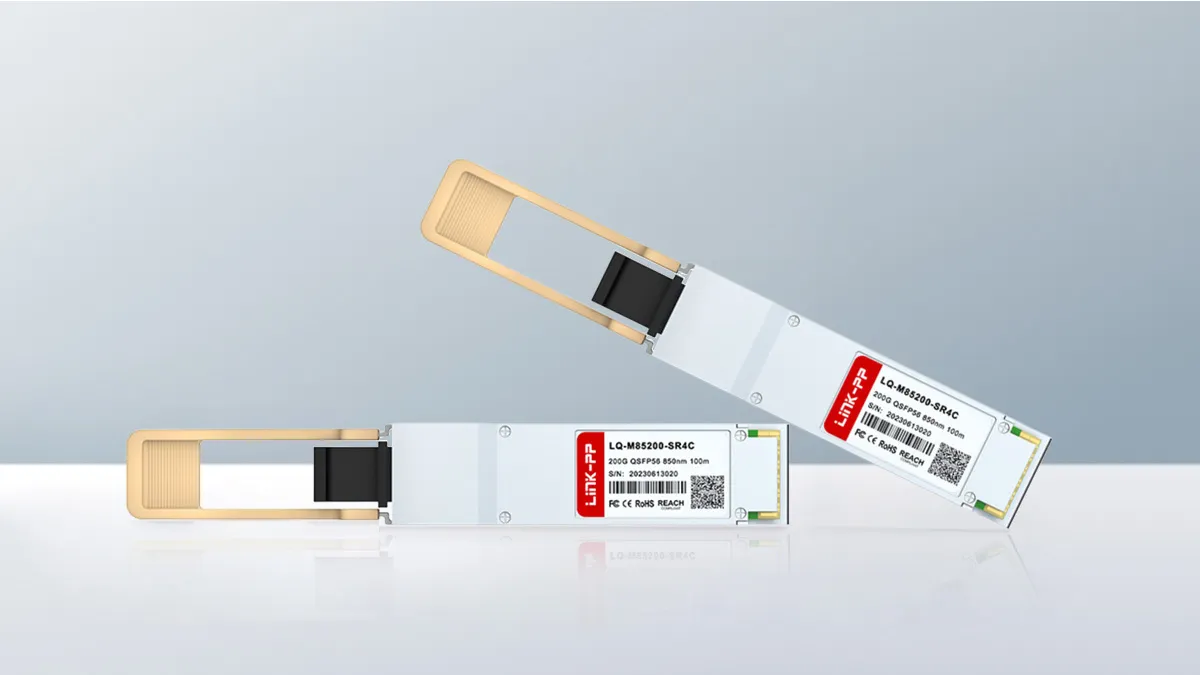
4. Architecture Solutions
QSFP56: DSP-Based Design
- Uses PAM4 to achieve 200G
- Requires digital signal processors for signal recovery
- Advantages: High fault tolerance and link optimization
- Trade-offs: Increased power consumption and cost
QSFP-DD: Fully Analog Architecture
- Typically NRZ-based, 8×25G
- Minimal DSP requirements
- Advantages: Lower power, simpler design, cost-effective
- Ideal for deployments prioritizing energy efficiency over absolute performance
5. Backward Compatibility
- QSFP-DD: Supports 4- and 8-lane configurations; backward-compatible with QSFP+, QSFP28, QSFP56, facilitating seamless migration between speeds.
- QSFP56: Compatible with QSFP+ and QSFP28, enabling gradual upgrades from 40G/100G to 200G.
Backward compatibility ensures investment protection and smoother network evolution, reducing replacement costs and operational disruption.
6. 200G QSFP56 Product Portfolio
200G QSFP56 SR4
- Full-duplex multimode fiber module
- 4×53.125 Gbps lanes, total 200G
- 850nm wavelength, compatible with OM3/OM4 fiber
- MTP/MPO-12 APC connector, 38-pin electrical interface
- Best for short-range interconnects in data centers
200G QSFP56 FR4
- Medium- to long-haul applications
- Quad-wavelength CWDM design with 1271–1331nm EML lasers
- Duplex LC optical interface, 38-pin electrical interface
- Supports up to 2 km transmission, suitable for campus networks or inter-building links
7. Practical Recommendations
- QSFP56: Optimal for networks where 200G suffices, emphasizing cost-efficiency and low power.
- QSFP-DD: Ideal for future-proofing toward 400G, with higher lane density and flexible modulation modes.
Deployment Tip: Organizations with stable 200G requirements can maximize efficiency with QSFP56, while those planning gradual 400G migration should invest in QSFP-DD for long-term ROI.
8. Conclusion
While QSFP-DD dominates 400G Ethernet, QSFP56 remains a reliable and efficient solution for current 200G deployments. Its balanced performance, power consumption, and compatibility make it a practical choice for medium- to large-scale networks. For networks preparing for a future 400G upgrade, QSFP-DD offers flexibility and scalability, enabling smooth migration while protecting investment value.
🔗 Related Topics & Further Reading
- What Is QSFP56? Differences from QSFP28 & QSFP56-DD (200G Guide)
- QSFP56-DD vs QSFP-DD: Key Differences, Use Cases & Selection Guide
- Differences Between QSFP-DD and QSFP, QSFP28, QSFP56, QSFP112, OSFP, and CFP2
- Understanding the QSFP56 Standard (SFF-8679): Enabling 200G Optical Interconnects with LINK-PP's Next-Gen Transceivers

-
Nav Menu
-
About LINK-PP
-
All Products
-
Applications