


Understanding the QSFP56 Standard (SFF-8679): Enabling 200G Optical Interconnects with LINK-PP’s Next-Gen Transceivers

LINK-PP Official ·


💡 Introduction: The Evolution Toward 200G Networks
As data traffic surges across hyperscale data centers and AI clusters, the need for higher bandwidth density and power efficiency continues to accelerate. While 100G networks are now ubiquitous, the next evolution — 200G Ethernet — bridges the gap toward full 400G deployments.
At the heart of this evolution lies the QSFP56 (Quad Small Form Factor Pluggable 56) standard, leveraging four lanes of 50G PAM4 signaling to deliver 200G per module within the same compact QSFP form factor.

Defined by the Small Form Factor (SFF) Committee through extensions of SFF-8665 and SFF-8679 specifications, QSFP56 enables data centers to double per-port throughput without increasing footprint or power envelope.
This article unpacks the QSFP56 standard, explains its design rationale, and explores how LINK-PP's 200G optical transceivers deliver full compliance and performance aligned with hyperscale demands.
✨ What Is the QSFP56 Standard?
The QSFP56 standard is the evolutionary successor to QSFP28. It maintains identical mechanical dimensions and electrical pin assignments, while upgrading the electrical interface to support PAM4 (Pulse Amplitude Modulation, 4-level) signaling at 53.125 Gb/s per lane.
In short, QSFP56 = QSFP28 form factor + 50G PAM4 lanes = 200G total bandwidth.
Technical Summary:
| Feature | QSFP28 | QSFP56 |
|---|---|---|
| Lane count | 4 | 4 |
| Signaling | NRZ (25G) | PAM4 (50G) |
| Aggregate bandwidth | 100G | 200G |
| Connector | 38-pin edge | Same as QSFP28 |
| Typical power | <3.5W | 4–5W |
| Primary standard | SFF-8665 | SFF-8679 / QSFP56 MSA |
| Primary applications | 100G Ethernet | 200G Ethernet / InfiniBand HDR |
QSFP56 is aligned with the IEEE 802.3cd specification for 50G PAM4 lanes, enabling 200GBASE-CR4, 200GBASE-SR4, and 200GBASE-FR4 optical links.
🔧 The Role of PAM4 Modulation in QSFP56
The jump from 25G NRZ (QSFP28) to 50G PAM4 doubles the bit rate without increasing the number of electrical lanes.
PAM4 (Pulse Amplitude Modulation with 4 levels) encodes two bits per symbol — effectively doubling the data rate over the same bandwidth.
PAM4 vs. NRZ Comparison
| Attribute | NRZ (QSFP28) | PAM4 (QSFP56) |
|---|---|---|
| Bits per symbol | 1 | 2 |
| Signal levels | 2 | 4 |
| Bandwidth requirement | Lower | Higher |
| Noise margin | Higher | Lower |
| Equalization complexity | Low | High |
| Data rate per lane | 25.78125 Gb/s | 53.125 Gb/s |
While PAM4 introduces increased signal complexity and reduced noise tolerance, QSFP56 compensates through enhanced equalization, error correction (FEC), and tighter electrical performance requirements.
🏢 Inside the QSFP56 Specification
The QSFP56 standard incorporates multiple interrelated documents:
- SFF-8665 — Mechanical and connector interface (retained from QSFP28)
- SFF-8679 — Electrical interface and signal integrity
- SFF-8636 — Management interface and diagnostic monitoring
- IEEE 802.3cd — Defines 50G PAM4 physical layer for Ethernet
Together, these specifications govern the complete design of a compliant QSFP56 module.
📐 Mechanical Envelope
QSFP56 modules maintain the same physical form factor (18.35 × 72 × 8.5 mm) and latching mechanism as QSFP28, allowing drop-in replacement and backward compatibility with cages and connectors.
⚡ Electrical and Thermal Parameters
- Operating voltage: 3.3V
- Max power: typically 5W
- Four transmit and receive differential pairs at 50G each
- Improved EMI shielding and low insertion loss design
🔌 Host-to-Module Interface
Using 38-pin edge connectors, QSFP56 supports:
- TX/RX data lanes
- I²C-based management signals (MOD_SEL, INTL, RESETL)
- Power and ground distribution
🛡️ Management and Diagnostics
The memory map remains consistent with SFF-8636, enabling seamless monitoring via digital diagnostics (DDM):
- Temperature, voltage, bias current
- Optical power
- Module identifier and vendor information
🔗 Compliance and Interoperability
QSFP56 retains mechanical compatibility with QSFP28 infrastructure. This allows data centers to upgrade to 200G ports using the same cages and connectors — a major cost and design advantage.
Compliance ensures:
- Mechanical backward compatibility
- Electrical signal integrity at 50G PAM4 per lane
- Robust I²C communication per SFF-8636
- Interoperability with major switch platforms (NVIDIA, Cisco, Arista, Huawei, Juniper)
Operators can gradually transition from 100G to 200G without disruptive hardware overhauls.
🚀 LINK-PP's QSFP56 Optical Transceiver Portfolio
LINK-PP, an industry-recognized designer and manufacturer of high-performance optical transceivers, fully aligns its 200G product line with QSFP56 standards.
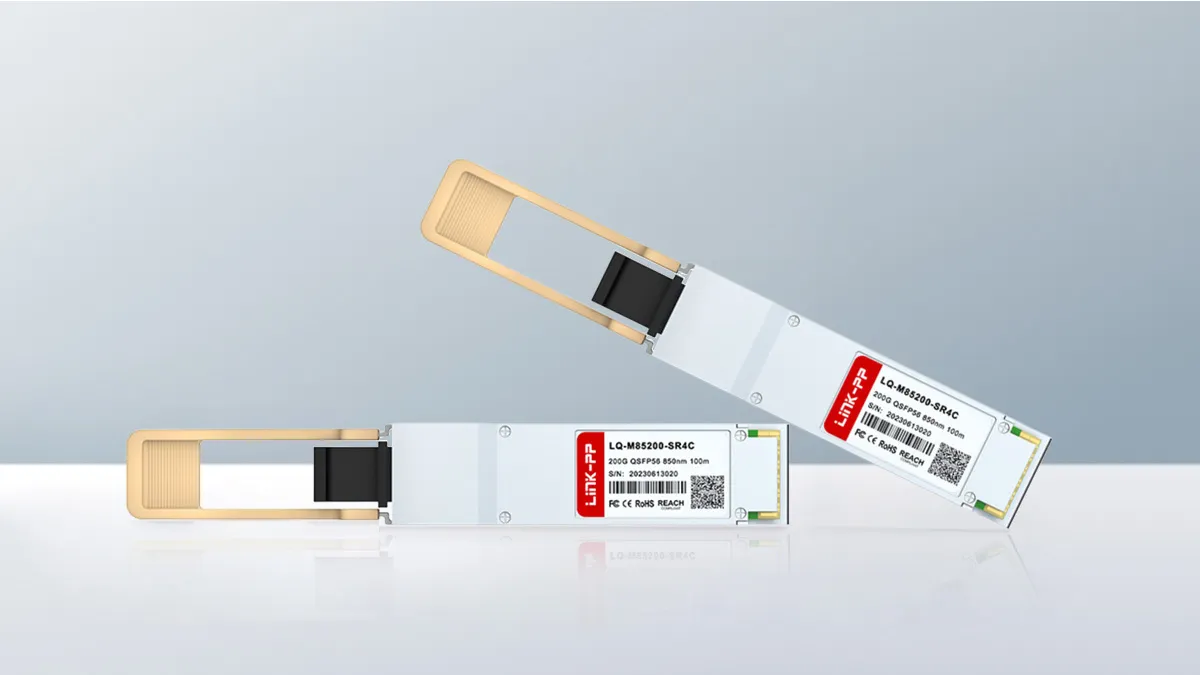
Each LINK-PP QSFP56 transceiver meets or exceeds SFF-8679 and IEEE 802.3cd specifications.
🔧 Technical Features
- Compliant with SFF-8665 and SFF-8679
- Supports PAM4 50G/lane electrical signaling
- Hot-pluggable QSFP form factor
- Low power consumption (<5W)
- DDM/DOM interface per SFF-8636
- Supports IEEE 802.3cd 200GBASE-SR4, FR4, DR4 standards
- Available for multimode and single-mode fiber
✨ Testing and Quality Control
All LINK-PP QSFP56 transceivers undergo:
- Bit Error Rate (BER) testing at 10^-12 levels
- Eye-diagram validation under PAM4 modulation
- Thermal cycling and shock tests (per GR-468-CORE)
- EMI/EMC compliance checks
- Interoperability testing with industry-leading switches
Ensuring field-proven reliability for AI networking, HPC clusters, and cloud-scale environments.
📈 Application Scenarios for QSFP56
The QSFP56 form factor enables network architects to achieve double the bandwidth density of 100G in the same space.
- 200G Ethernet spine-leaf interconnects
- AI training clusters and GPU server fabrics
- 5G mobile fronthaul and midhaul
- Edge data centers and microclouds
- Telecom and metro aggregation networks
Leveraging PAM4, QSFP56 modules provide a cost-effective stepping stone between QSFP28 (100G) and QSFP-DD (400G), balancing power, cost, and upgrade flexibility.
✅ Technical and Commercial Benefits
High Density and Scalability
Maintains QSFP form factor while doubling data rate per port.
Lower Power per Bit
PAM4 signaling enables 200G throughput with minimal power increase.
Cost-Effective Upgrade Path
Backward-compatible design reduces total cost of ownership (TCO).
Proven Reliability
Standardized thermal envelope and EMI shielding enhance long-term durability.
Seamless Migration
Allows incremental scaling toward 400G without forklift upgrades.
📄 Reference Standard Document (PDF)
Official Reference:
SFF-8679 – QSFP Electrical Interface Specification
Issued by: Small Form Factor Committee (SFF)
Latest Revision: 1.9 (Active, 2025)
📄 https://members.snia.org/document/dl/25969
Also relevant:
IEEE 802.3cd-2018 – 50G, 100G, and 200G Ethernet PHYs
📄 https://standards.ieee.org/ieee/802.3cd/6754/
🌟 Conclusion: LINK-PP Powers the Transition to 200G Networks
The QSFP56 standard represents a critical milestone in optical interconnect evolution, merging the mature QSFP ecosystem with PAM4 signaling performance.
Through engineering excellence and full compliance with SFF-8679, SFF-8665, and IEEE 802.3cd, LINK-PP QSFP56 transceivers enable data centers to double bandwidth density while maintaining efficiency, interoperability, and scalability.
As enterprises, telecom providers, and hyperscale operators modernize infrastructure for AI workloads, LINK-PP is a trusted optical partner, delivering standards-compliant solutions for high-speed connectivity from 100G to 400G and beyond.
Related Topics & Further Reading

-
Nav Menu
-
About LINK-PP
-
All Products
-
Applications