


What Is QSFP56? Differences from QSFP28 & QSFP56-DD (200G Guide)

LINK-PP Official ·


The demand for faster, more efficient interconnects is skyrocketing with the growth of AI training clusters, 5G backhaul, hyperscale data centers, and high-performance computing (HPC). To bridge the gap between 100G and 400G networking, the QSFP56 (Quad Small Form-Factor Pluggable 56) has emerged as a leading 200G optical transceiver solution.
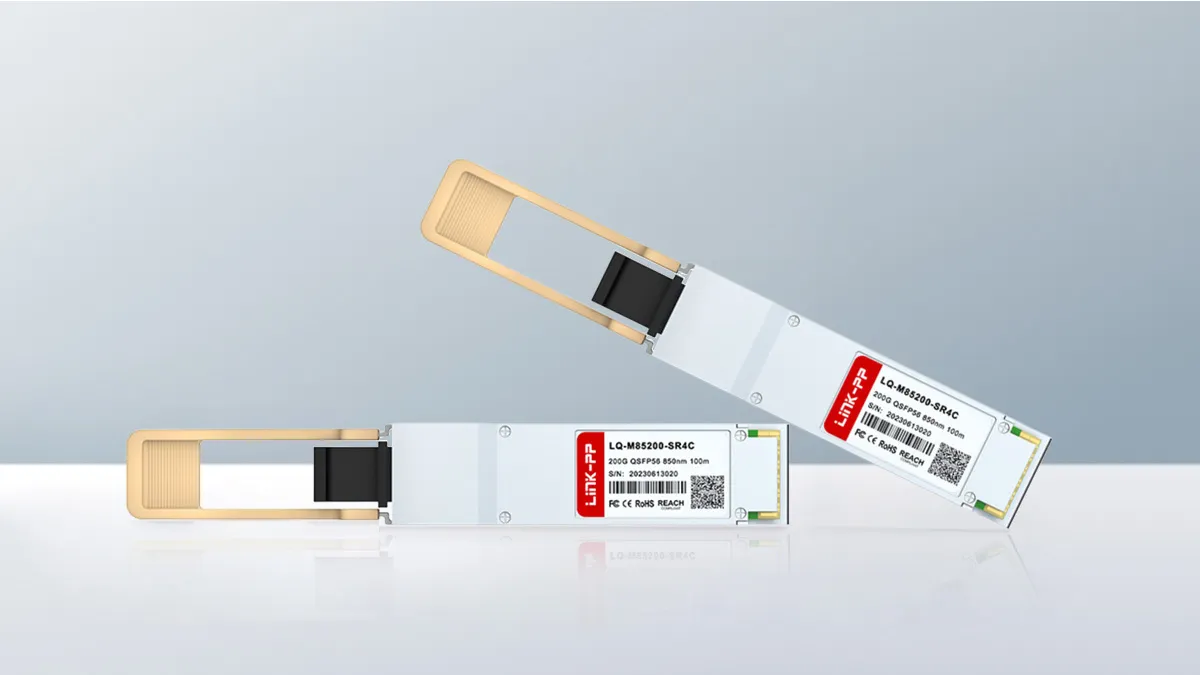
This article explores QSFP56 in depth—its specifications, module types, evolution within the QSFP family, comparisons with other standards, and its role in the migration toward 400G networks. By the end, you’ll have a clear understanding of how QSFP56 fits into modern connectivity strategies.
🔄 Evolution of the QSFP Family
The QSFP form factor was developed as a successor to SFP, offering four high-speed lanes in the same compact module size. Over the years, it has evolved to meet ever-higher bandwidth requirements:
- QSFP+ (40G) – 4×10G lanes, supporting 40GbE and InfiniBand QDR.
- QSFP28 (100G) – 4×25G NRZ lanes, widely deployed in cloud-scale networks.
- QSFP56 (200G) – 4×50G PAM4 lanes, delivering 200GbE while retaining the same physical footprint as QSFP28.
- QSFP56-DD (400G) – “Double Density,” doubling the lane count to 8×50G PAM4, enabling 400GbE and backward compatibility with QSFP56.
This roadmap highlights QSFP56 as the strategic midpoint—an ideal step for organizations needing more than 100G but not yet ready for the full investment of 400G infrastructure.
💡 What is QSFP56?
The QSFP56 is a 200G Ethernet optical transceiver that uses PAM4 modulation to achieve 50Gbps per lane across four lanes.
- Form Factor: Identical in size to QSFP28 (18.35mm × 8.5mm × 72mm).
- Speed: 4×50G = 200Gbps aggregate bandwidth.
- Backward Compatibility: Can operate in 100G mode when connected to QSFP28-compatible ports (depending on switch/vendor support).
- Applications: AI workloads, 5G transport, data center aggregation, and enterprise backbones.
📝 QSFP56 Module Variants
QSFP56 transceivers are available in multiple versions, each designed for specific reach and cabling requirements:
- QSFP56 SR4 (Short Range) – Up to 100m over OM4 multimode fiber.
- QSFP56 FR4 (Medium Reach) – Up to 2km over single-mode fiber.
- QSFP56 LR4 (Long Reach) – Up to 10km for metro and core networks.
- QSFP56 DR (Data Center Reach) – Optimized for ~500m over SMF.
- QSFP56 DAC (Direct Attach Copper) – Low-cost, ≤3m connections.
- QSFP56 AOC (Active Optical Cable) – Flexible for 5–50m interconnects.
Breakout Options:
- 200G QSFP56 → 2×100G QSFP28
- 200G QSFP56 → 4×50G SFP56
This versatility supports staged migrations and diverse topologies in large-scale deployments.
🏭 Real-World Example: LINK-PP QSFP56-SR4
At LINK-PP, we provide QSFP56 solutions that make these concepts tangible. A representative case is our 200G QSFP56-SR4 transceiver, designed for short-reach connections in modern data centers.
| Feature | LINK-PP QSFP56-SR4 Specification |
|---|---|
| Data Rate | 200Gbps (4 × 50G PAM4) |
| Wavelength | 850nm |
| Fiber Type | OM3 / OM4 multimode fiber |
| Reach | ~70m (OM3), up to 100m (OM4) |
| Connector | MPO/MTP-12 |
| Power Consumption | ≤3.3W |
| Diagnostics | DOM via I²C, CMIS V4.0 compliant |
| Operating Temp. | 0°C to 70°C |
| Compliance | IEEE 802.3cd, QSFP MSA, RoHS |
This module is ideal for server-to-switch or leaf-to-spine connections, where low power consumption and reliable short-distance transmission are key. Because it complies with global standards, it ensures seamless interoperability while helping operators scale from 100G to 200G smoothly.
⚖️ QSFP56 vs. QSFP28 vs. QSFP+
Although QSFP+, QSFP28, and QSFP56 share the same compact form factor, their speed, encoding, and use cases differ significantly.
| Parameter | QSFP+ | QSFP28 | QSFP56 |
|---|---|---|---|
| Max Data Rate | 40G (4×10G) | 100G (4×25G) | 200G (4×50G) |
| Modulation | NRZ | NRZ | PAM4 |
| Typical Use Case | 40GbE, InfiniBand | 100GbE networks | 200GbE upgrades |
👉 Key Differentiator: QSFP56 introduces PAM4 modulation, doubling per-lane throughput compared to QSFP28, making it well-suited for hyperscale data centers and AI-driven architectures.
🚀 QSFP56 vs. QSFP56-DD (400G)
While QSFP56 is designed for 200G Ethernet, its direct successor QSFP56-DD (Double Density) scales bandwidth to 400G by increasing the lane count from 4 to 8.
- QSFP56: 4×50G PAM4 = 200G
- QSFP56-DD: 8×50G PAM4 = 400G
- Size: Same physical dimensions as QSFP56.
- Backward Compatibility: QSFP56-DD ports can operate with QSFP56 modules in 200G mode.
Thus, QSFP56-DD is recognized as the dominant 400G form factor, while QSFP56 continues to serve as a bridge technology for cost-effective 200G deployments.
🛤️ Migration Path: 100G → 200G → 400G
Network upgrades typically follow a staged approach:
- QSFP28 (100G) – The current standard for enterprise and cloud data centers.
- QSFP56 (200G) – Doubles capacity with minimal disruption.
- QSFP56-DD (400G) – Hyperscale-ready for next-gen AI clusters and massive east-west traffic.
By adopting QSFP56 as an intermediate step, operators can scale capacity gradually while protecting their investment in existing infrastructure.
📡 Industry Standards and Vendor Support
The deployment of QSFP56 is supported by the IEEE 802.3bs (200G Ethernet standard) and various multi-source agreements (MSAs). Major networking vendors—including Cisco, Arista, NVIDIA/Mellanox, Huawei, and Juniper—have incorporated QSFP56 optics into their product portfolios, ensuring interoperability and global adoption.
❓ FAQ: Quick Answers about QSFP56
Q1: Is QSFP56 backward compatible with QSFP28?
Yes, many QSFP56 modules can operate at 100G in compatible QSFP28 ports, depending on switch support.
Q2: Can QSFP56 be used for breakout connections?
Absolutely. QSFP56 supports 2×100G or 4×50G breakout options for flexible topologies.
Q3: Why does QSFP56 use PAM4 modulation instead of NRZ?
PAM4 enables 50Gbps per lane, doubling throughput compared to NRZ while maintaining the same number of lanes.
Q4: Who should consider QSFP56 instead of jumping directly to 400G?
Organizations seeking a cost-effective bandwidth upgrade without the expense of full 400G deployments.
📌Conclusion: Are You Ready for QSFP56?
The QSFP56 module is more than just a 200G transceiver—it represents a strategic stepping stone in the evolution from 100G to 400G networking. With its compact design, PAM4 modulation, and flexible breakout options, QSFP56 empowers enterprises, telecom providers, and hyperscale operators to scale bandwidth efficiently and cost-effectively.
By understanding the QSFP family evolution, module types, comparisons, and migration strategies, you can make informed decisions about deploying QSFP56 in your network. As digital infrastructure races toward AI-driven and cloud-scale applications, QSFP56 stands as a reliable, future-ready solution.
🔗 Related Topics & Further Reading
Tags:

-
Nav Menu
-
About LINK-PP
-
All Products
-
Applications