


SFP Compatibility Master Guide: SFP+ vs SFP28 vs QSFP28 Interoperability

LINK-PP Official ·


The Ultimate Guide to SFP Compatibility: Interoperability, Standards, and Deployment Strategies
Unlock seamless network integration with our comprehensive SFP compatibility framework—covering interoperability nuances, market-proven configurations, and future-proofing strategies for enterprise infrastructure.
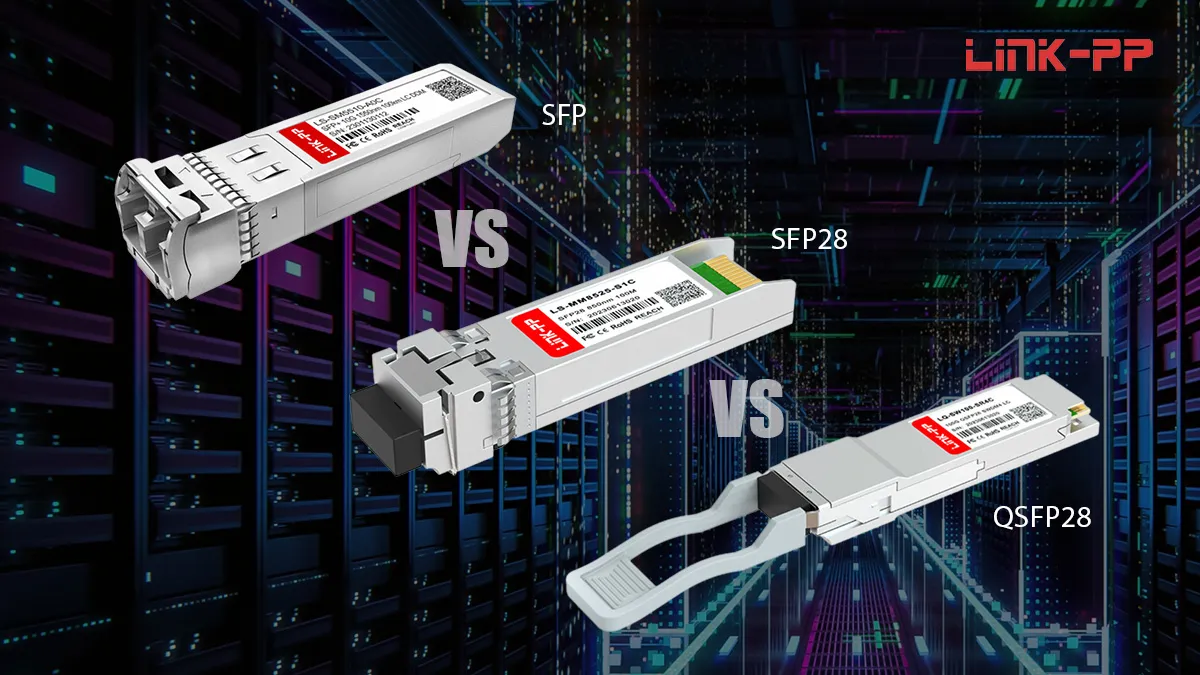
The Critical Role of SFP Standards in Modern Networks
Small Form-factor Pluggable (SFP) transceivers are the backbone of high-speed data networks, enabling flexible connectivity across switches, routers, and servers. With the global SFP market projected to reach $12.3 billion by 2030 (CAGR 8.0%) , understanding compatibility nuances isn’t just technical—it’s economic. This guide synthesizes IEEE standards, vendor documentation, and real-world deployment data to demystify interoperability across SFP generations. We prioritize actionable insights for network architects, including:
-
Cost-saving compatibility workarounds
-
Performance tradeoffs in mixed-speed deployments
-
Future-ready migration strategies
Decoding SFP Generations: Technical Specifications & Protocol Support
SFP (1G/2.5G/4G Capabilities)
-
Standards Compliance: SFF-8472 protocol
-
Physical Interface: LC duplex or RJ45 copper
-
Speed Limitations: Max 4Gbps; incompatible with 10G+ uplinks
-
Use Cases: Legacy switches, campus LAN access layers
SFP+ (10G/16G Evolution)
-
Critical Upgrade: SFF-8431/SFF-8432 protocols enabling 10G channels
-
Backward Compatibility: Accepts SFP modules but downgrades port to 1G (Cisco/Brocade validated) 210
-
Copper Support: Direct-attach cables (DACs) under 7m; 10GBASE-T over CAT6a
SFP28 (25G/32G Future-Proofing)
-
Bandwidth Leap: 25Gb/s single-lane architecture
-
Interoperability: Physically fits SFP+ slots but negotiates at 10G unless both ends support 25G
-
Market Traction: Fastest-growing segment due to 5G backhaul and cloud data centers
QSFP+/QSFP28 (40G/100G/400G Density)
-
Channel Architecture: 4×10G (QSFP+) or 4×25G (QSFP28) lanes
-
Breakout Options: QSFP28-to-4xSFP28 DAC for 100G→25G fanout
-
Vendor Warnings: QSFP+ in QSFP28 slots possible only with explicit switch support
Compatibility Decision Framework: What Works With What?
Forward/Backward Scenarios
-
✅ SFP in SFP+ Port: Operates at 1G (Ideal for temporary legacy device integration)
-
❌ SFP+ in SFP Port: Physical damage risk; protocol mismatch
-
⚠️ Mixed-Speed Links: SFP28-to-SFP+ links default to 10G; requires auto-negotiation toggle
Vendor-Specific Behaviors (Verified via TAC Cases)
| Vendor | SFP+ Slot Supports 1G SFP? | Notes |
|---|---|---|
| Cisco | Yes (Default) | Auto-negotiation mandatory |
| Juniper | With CLI override | set interfaces speed 1g |
| Arista | Yes | Tested on 7050X3 series |
| Brocade | No | Hardware-limited |
Market Trends & Application-Specific Selection
Data Center Dominance (65% of SFP28 Revenue)
-
25G Server Uplinks: SFP28 DACs replacing 10G SFP+ for AI/ML workloads
-
100G Spine Links: QSFP28-100G-SR4 optics at $199/port (vs. $349 in 2023)
5G Transport Revolution
-
Fronthaul: 25G SFP28 CWDM optics in RU-mounted switches
-
Backhaul: QSFP28 ER4 Lite for 40km DWDM rings
Industrial IoT Constraints
-
Extended temperature SFP variants (-40°C to 85°C)
-
Moxa/Advantech hardened transceivers for vibration resilience
Key Technical Comparison: SFP Generations
Table: Critical Parameters for Informed SFP Selection
| Form Factor | Max Speed | Protocol | Typical Reach | Power Draw | Cost Index |
|---|---|---|---|---|---|
| SFP | 4.25 Gbps | SFF-8472 | 80km (SMF) | 1W | 1.0x |
| SFP+ | 16 Gbps | SFF-8431/8432 | 10km (10GBASE-LR) | 1.5W | 1.8x |
| SFP28 | 28 Gbps | SFF-8402 | 80km (25GBASE-LR) | 2W | 3.5x |
| QSFP+ | 40 Gbps | SFF-8436 | 100m (OM4 MMF) | 3.5W | 4.0x |
| QSFP28 | 100 Gbps | SFF-8665 | 2km (100GBASE-SR4) | 4W | 8.7x |
*Source: IEEE 802.3bm/cd* 2025 Q1 data
FAQ: Expert Answers to Top Compatibility Queries
Q1: Can QSFP28 ports accept QSFP+ optics?
Yes—if the switch explicitly supports 40G mode (e.g., Arista 7280CR). Use interface qsfp28 mode break-out 4x10g for 40G→4x10G splitting.
Q2: Why does SFP in SFP+ port cause link flap?
*Older SFP modules lack CDR (Clock Data Recovery) circuits. Set port speed manually to 1G and disable auto-negotiation.*
Q3: Is 25G SFP28 backward compatible with 10G switches?
Electrically yes—but requires software override. Not recommended for production environments due to packet loss risks.
Upgrade your network with a future-ready solution—order today.
Tags:

-
Nav Menu
-
About LINK-PP
-
All Products
-
Applications