


What is CXP Modules?CXP Transceiver Module Technology Overview

LINK-PP Official ·


As networks evolve toward cloud-scale data centers, high-performance computing (HPC) clusters, and enterprise core aggregation, the demand for compact and high-throughput optical modules has intensified. Among the different 100G solutions, the CXP transceiver module plays a key role in delivering ultra-high-density, short-reach optical connectivity.
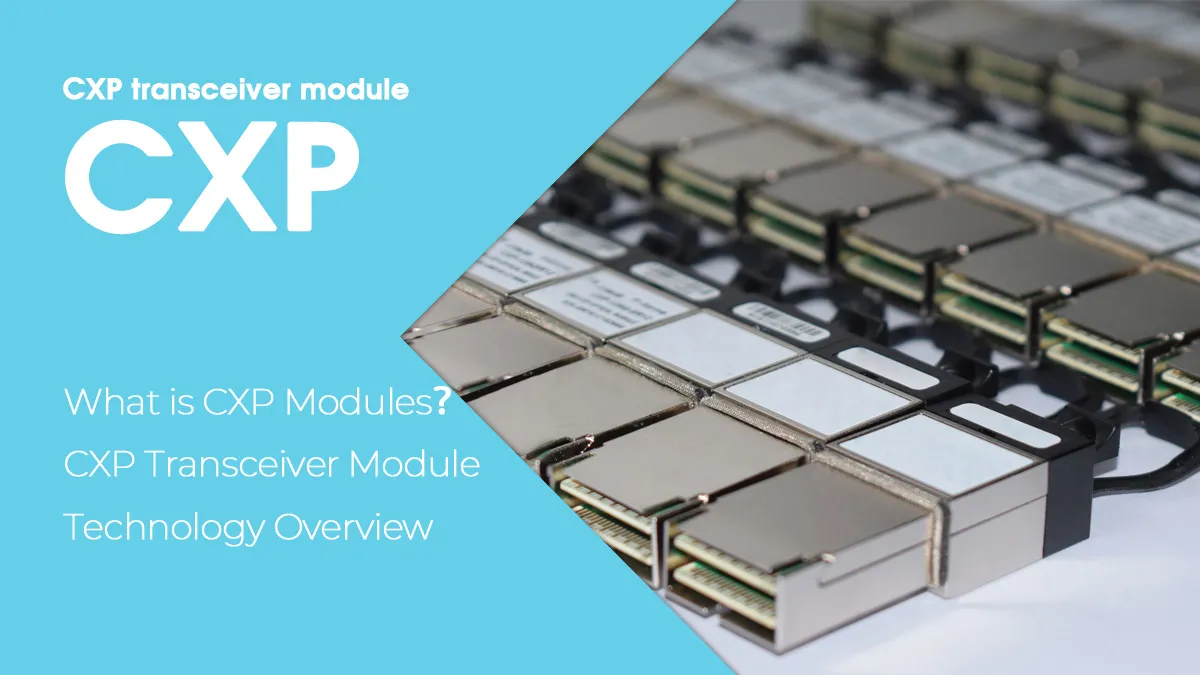
📘 What Is a CXP Transceiver Module?
The CXP (Compact 100G Pluggable) is a hot-swappable optical transceiver designed to support short-reach parallel optical interconnects. Compared with larger form factors like CFP, CXP offers higher port density, making it suitable for data centers and HPC environments.
- Size: 45mm × 27mm (slightly larger than XFP, but much denser in capacity)
- Channels: 12 transmit and 12 receive channels
- Per-Lane Speed: 10Gbps, achieving up to 120Gbps total bandwidth
- Distance: 100m on OM3, 150m on OM4 multimode fiber
- Interfaces:
- Electrical: 84-pin edge connector
- Optical: 24-fiber MPO/MTP connector
👉 How CXP Module Works?
CXP modules use parallel optics technology:
- Electrical input: 12 × 10Gbps signals enter via the 84-pin connector.
- Optical conversion: The signals are converted into 12 optical channels using 850nm VCSEL laser arrays.
- Transmission: The optical signals travel through a 24-core multimode MPO/MTP fiber cable.
- Reception: At the receiving end, the module uses a PIN photodiode array to convert light back into electrical signals.

This design allows low-latency and high-throughput interconnections, ideal for rack-to-rack and node-to-node networking.
⚡ Connection Scenarios of CXP Modules
CXP supports multiple connection schemes, making it versatile in short-reach optical networking:
- ✅ CXP to CXP Direct Connection (120G-120G)
- Uses a 24-core MTP trunk cable
- Provides full 120Gbps bidirectional bandwidth
- ✅ CXP to 3× QSFP+ (120G-3×40G)
- MTP breakout cable splits into 3 QSFP+ ports
- Common in networks transitioning from 40G to 100G
- ✅ CXP to 12× SFP+ (120G-12×10G)
- Breakout into 12 LC duplex connectors
- Allows interconnection with multiple 10G devices
⚠ Note on Compatibility:
- CXP cannot directly connect to QSFP-SR4, even though both operate at 850nm.
- QSFP uses 4 lanes, while CXP uses 12 lanes.
- Breakout connectivity requires matching wavelength transceivers (e.g., 850nm SFP+).
📏 Standards & Compliance
CXP modules are designed under the CXP MSA (Multi-Source Agreement) and adhere to strict safety and environmental standards:
- RoHS 6 compliant (environmentally friendly, lead-free)
- Laser Class 1 IEC / CDRH compliant (eye-safe operation)
These certifications ensure safety, interoperability, and sustainability across different platforms and vendors.
🏢 Applications of CXP Modules
- High-Performance Computing (HPC): Cluster interconnects for parallel processing
- Data Center Switching: Short-reach links between core and aggregation layers
- InfiniBand Systems: Support for QDR and FDR InfiniBand environments
- Enterprise Backbone: High-capacity aggregation within large campuses
- Test & Measurement: Used in lab setups requiring high-density optical channels
⭐ Advantages of CXP Transceivers
- High Port Density – Up to 120Gbps per module in a compact form factor
- Flexible Connectivity – Supports breakout into 40G and 10G environments
- Low Latency – Optimized for short-reach deployments requiring speed and reliability
- Scalable Bandwidth – Parallel channel architecture enables modular upgrades
- Ease of Deployment – MPO/MTP cabling reduces fiber management complexity
⚡ Industry Perspective: CXP in the Networking Ecosystem
While CXP once stood at the forefront of 100G adoption, the ecosystem has largely shifted to QSFP28, OSFP, and QSFP-DD for broader scalability (100G, 400G, and beyond).
However, CXP modules remain relevant in:
- Existing HPC clusters
- Legacy InfiniBand environments
- Data centers requiring dense, short-reach interconnects
They continue to serve as a reliable bridge technology, ensuring that organizations can extend the life of their current infrastructure while gradually migrating to newer optical platforms.
❓ Frequently Asked Questions (FAQ)
Q1. What is the maximum data rate of a CXP transceiver?
CXP modules typically support an aggregate bandwidth of up to 120Gbps, achieved through 12 transmit and 12 receive lanes at 10Gbps each.
Q2. How far can a CXP transceiver transmit data?
CXP modules are optimized for short-reach deployments:
- Up to 100m over OM3 multimode fiber
- Up to 150m over OM4 multimode fiber
Q3. Can a CXP module connect directly to a QSFP or QSFP28 module?
No. While both operate at 850nm wavelengths, CXP uses 12 parallel lanes, whereas QSFP only uses 4 lanes. Direct connections are not compatible without a breakout cable or conversion setup.
Q4. What are the common breakout options for CXP modules?
CXP modules can be connected in three main ways:
- CXP to CXP (120G to 120G)
- CXP to 3× QSFP+ (120G to 3×40G)
- CXP to 12× SFP+ (120G to 12×10G)
Q5. Is the CXP transceiver still relevant in modern networks?
Yes. Although newer form factors like QSFP28, QSFP-DD, and OSFP dominate current 100G–800G deployments, CXP remains relevant in legacy HPC clusters, InfiniBand systems, and short-range enterprise backbones.
Q6. What compliance standards do CXP modules meet?
They are MSA (Multi-Source Agreement) compliant, RoHS 6 certified, and Laser Class 1 IEC/CDRH safe, ensuring interoperability, safety, and environmental responsibility.
📌 Conclusion
The CXP transceiver module is a compact, high-density solution for short-reach optical networking, capable of delivering up to 120Gbps over multimode fiber. With parallel optics, flexible breakout options, and compliance with industry standards, CXP remains a valuable component in HPC clusters, enterprise backbones, and specialized data center deployments.
Although newer form factors dominate the market, CXP maintains its niche role by providing efficient, scalable, and cost-effective connectivity for environments that demand high bandwidth and short-distance interconnects.
🔗 Related Topics & Further Reading
Tags:

-
Nav Menu
-
About LINK-PP
-
All Products
-
Applications