


Optical Network Unit (ONU): Definition, Working Principles, and Future Outlook

LINK-PP Official ·


As global demand for ultra-broadband connectivity accelerates, Passive Optical Networks (PONs) have become the backbone of modern access infrastructures. From delivering gigabit Internet to homes, supporting 5G backhaul, to enabling enterprise cloud connectivity, fiber access networks are expanding rapidly. At the edge of this network lies the Optical Network Unit (ONU), bridging the operator's fiber infrastructure and the end-user's devices.
This article provides a deep-dive analysis of ONU technology, including its history, role in PON ecosystems, working principles, components, standards, management, deployment, troubleshooting, and future evolution toward next-generation fiber access.
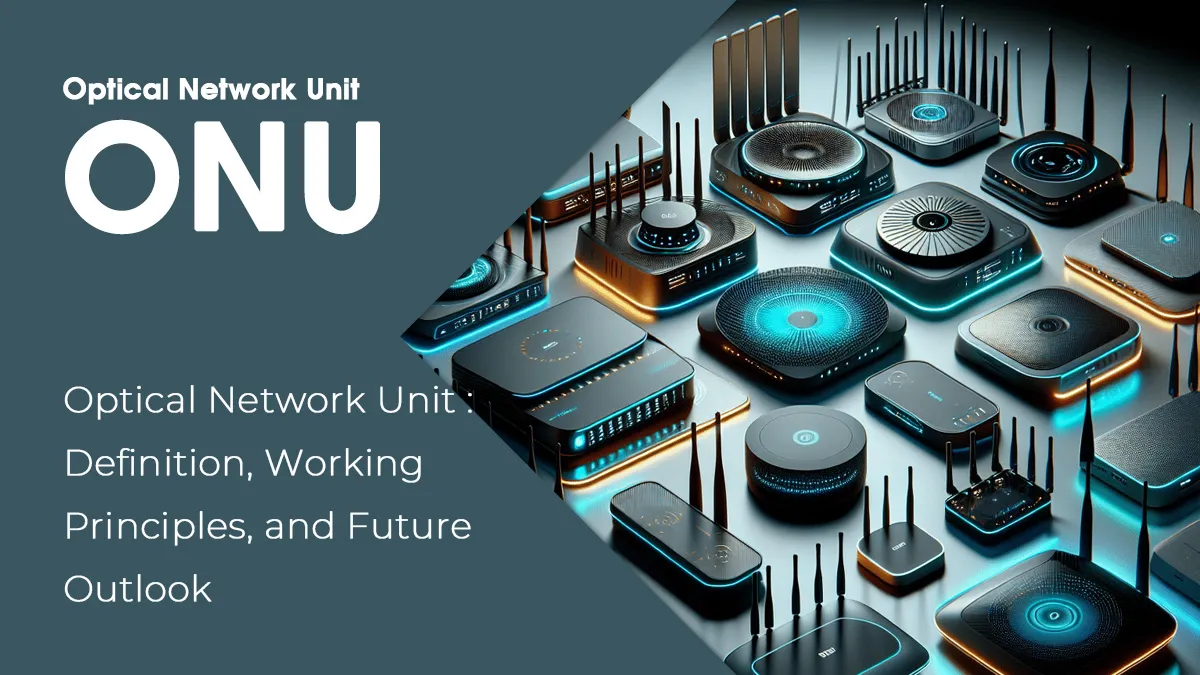
💡 What Is an Optical Network Unit (ONU)?
The ONU is a key customer-side device in PONs. It was developed in the late 1990s and early 2000s, converting optical signals from the ISP into electrical signals usable by routers, computers, IP phones, or Wi-Fi access points. Think of it as a sophisticated translator, turning the "language of light" into the "language of electricity."
While ONT typically refers to a single-user device inside a home, ONU can serve multiple users in buildings or curb cabinets. Many ISPs use the terms interchangeably for consumer equipment.
📊 ONU vs. ONT vs. Modem: Key Differences
| Feature | ONU | ONT | Traditional Cable Modem |
|---|---|---|---|
| Network Type | Fiber-to-the-X (FTTB, FTTC) | Fiber-to-the-Home (FTTH) | Coaxial Cable |
| Typical Location | Building comms room (MDU) | Inside home/office | Inside home/office |
| Function | Converts optical signal for multiple users | Converts optical signal for a single user | Converts RF signal to digital data |
| Medium | Fiber Optic Cable | Fiber Optic Cable | Coaxial Cable |
In practice, ONUs serve multiple subscribers (e.g., in a building), while ONTs typically serve a single household. Both are fiber optic modems, distinct from traditional cable modems.
✨ ONU Components
- Optical Transceiver: Converts optical signals to electrical and vice versa. Modern ONUs may support pluggable modules like SFP/SFP+ for flexibility and future upgrades.
- Electrical Interfaces: Ethernet (RJ45), phone (RJ11), coaxial ports.
- Media Conversion: Bi-directional optical-electrical signal handling.
- Traffic Management & QoS: Prioritization, VLAN, and latency-sensitive traffic handling.
- Authentication & Security: User verification and encryption.
- Service Provisioning & Remote Management: Remote configuration via OMCI and firmware updates.
- Power & Cabling: Operates via external adapter or PoE, often including passive or active cabling.
- Housing: Indoor or outdoor enclosure, ruggedized if needed for environmental conditions.
🔁 How an ONU Works
- Optical Signal Reception: Receives downstream signals from the OLT.
- Signal Demodulation: Converts optical signals into electrical form for processing.
- Data Processing: Handles internet, voice, and video streams.
- Traffic Separation & QoS: Prioritizes latency-sensitive traffic according to service-level agreements (SLAs).
- Service Delivery: Sends processed data to customer devices via electrical interfaces.
- Upstream Data Modulation: Converts electrical signals from devices back to optical form.
- Optical Transmission to OLT: Sends modulated signals upstream over shared fiber.
- OLT/ONT Coordination: Synchronizes transmission timing and routes upstream data.
- Authentication & Security: Verifies authorized access and applies encryption for privacy.
- Remote Management: Allows operators to configure, monitor, and troubleshoot ONUs without on-site visits.
🛡️ Standards and Protocols
- GPON (ITU-T G.984): 2.5 Gbps downstream, 1.25 Gbps upstream.
- EPON (IEEE 802.3ah/av): Ethernet-native PON, widely deployed in Asia.
- XGS-PON (ITU-T G.9807): Symmetric 10 Gbps upstream/downstream.
- NG-PON2: WDM-based PON offering multiple 10 Gbps channels per fiber.
- Emerging 25G/50G-PON: Supporting ultra-HD video, AI, VR/AR, and future broadband needs.
✨ Types of ONUs: Choosing the Right One
- Bridge ONU: Converts fiber to Ethernet; requires separate router. Ideal for high-end personal routers.
- Wi-Fi ONU: Combines modem, router, and wireless access point. Common ISP-supplied unit.
- GPON ONU: Compliant with GPON standards, offering high-efficiency, ultra-fast broadband.
⚙️ ONU Management and Control
ONUs use OMCI (ITU-T G.988) and related protocols to allow remote configuration, monitoring, and firmware updates. Key features include:
- Performance monitoring (optical power, packet counters)
- VLAN, QoS, and port management
- Alarm reporting and automated recovery
📈 Performance, QoS, and Security
- Bandwidth control and traffic shaping per service/port
- Low-latency QoS for voice and IPTV
- Authentication, encryption, and MAC/port isolation
🏠 Deployment Scenarios
- FTTH: ONU installed inside homes
- FTTB/FTTD: ONU in building basement or closet
- MDU: Shared ONU serving multiple apartments
- Enterprise & 5G Backhaul: High-capacity ONUs for symmetrical bandwidth
✨ Optical Transceivers in ONUs
The optical transceiver module is the "eyes" of the ONU, enabling electro-optical conversion and flexible deployment. Modern ONUs support pluggable SFP/SFP+ modules for:
- Changing fiber connector type (SC, LC)
- Upgrading standards (GPON → XGS-PON)
- Future-proofing networks with minimal hardware replacement
Devices from LINK-PP exemplify modular ONU solutions for evolving broadband needs.
❗ Troubleshooting Common ONU Issues
- Optical power loss due to dirty connectors or fiber bends
- Ranging failures from timing mismatches with OLT
- Bandwidth congestion from misconfigured QoS
- Firmware incompatibility resolved by updates
🚀 Future Evolution of ONU Technology
- Migration to XGS-PON, NG-PON2, 25G/50G-PON
- Virtualized ONUs integrated with SDN/NFV
- Edge intelligence for local caching and AI workloads
- Convergence of fixed and mobile networks
🔗 LINK-PP Solutions for ONU Deployments
LINK-PP is a leading global manufacturer specializing in RJ45 connectors, optical modules (SFP), LAN transformers, and fiber optic cages & connectors. Their high-quality components empower telecom operators, data centers, and networking integrators to build and scale next-generation communication infrastructure, including ONU and FTTx networks.
Backed by decades of experience, advanced R&D labs, automated SMT production, and ISO-certified quality control, LINK-PP ensures reliable, interoperable, and high-performance connectivity for ONU deployments. Their solutions are compatible with major networking brands, supporting efficient, scalable, and cost-effective fiber-optic and Ethernet networks.
With a global inventory system and strategic partnerships, LINK-PP delivers fast fulfillment and eco-friendly solutions, making it a trusted partner for deploying ONUs and maintaining robust, high-speed broadband access.
❓ FAQ
📝 What does an ONU look like?
Small box with indicator lights and ports; some models are indoor, others outdoor.
📝 What happens if your ONU stops working?
You lose internet connectivity. Check power and cables first, then contact your ISP.
📝 What devices connect to an ONU?
Routers, computers, smart TVs, phones, game consoles via Ethernet or POTS ports.
📝 What should you do before replacing your ONU?
Ensure compatibility with your ISP and network standard. Follow setup instructions carefully.
📌 Conclusion
The Optical Network Unit (ONU) is central to FTTx deployments, converting optical signals into usable services and ensuring efficient, secure, and reliable connectivity. As broadband standards evolve to 10G, 25G, and beyond, ONUs will become more intelligent, programmable, and service-aware, supporting the next generation of digital services, including 5G and edge computing.
🔗 Related Topics & Further Reading
Tags:

-
Nav Menu
-
About LINK-PP
-
All Products
-
Applications