


Demystifying Fiber Optics: Critical Differences Between QSFP and SFP Transceivers

LINK-PP Official ·


Why Transceiver Choice Reshapes Network Performance
Fiber optic transceivers like QSFP (Quad Small Form-Factor Pluggable) and SFP (Small Form-Factor Pluggable) serve as the critical interface between network hardware and optical cabling. While both enable high-speed data transfer, their structural designs dictate vastly different capabilities. QSFP integrates four independent channels within a marginally larger footprint (38.1mm × 50.8mm × 14mm vs. SFP's 29.7mm × 50.8mm × 13mm), enabling aggregated bandwidth up to 400G with QSFP-DD. SFP's single-channel architecture limits peak speeds to 10G (SFP+) but offers superior flexibility for cost-sensitive deployments.
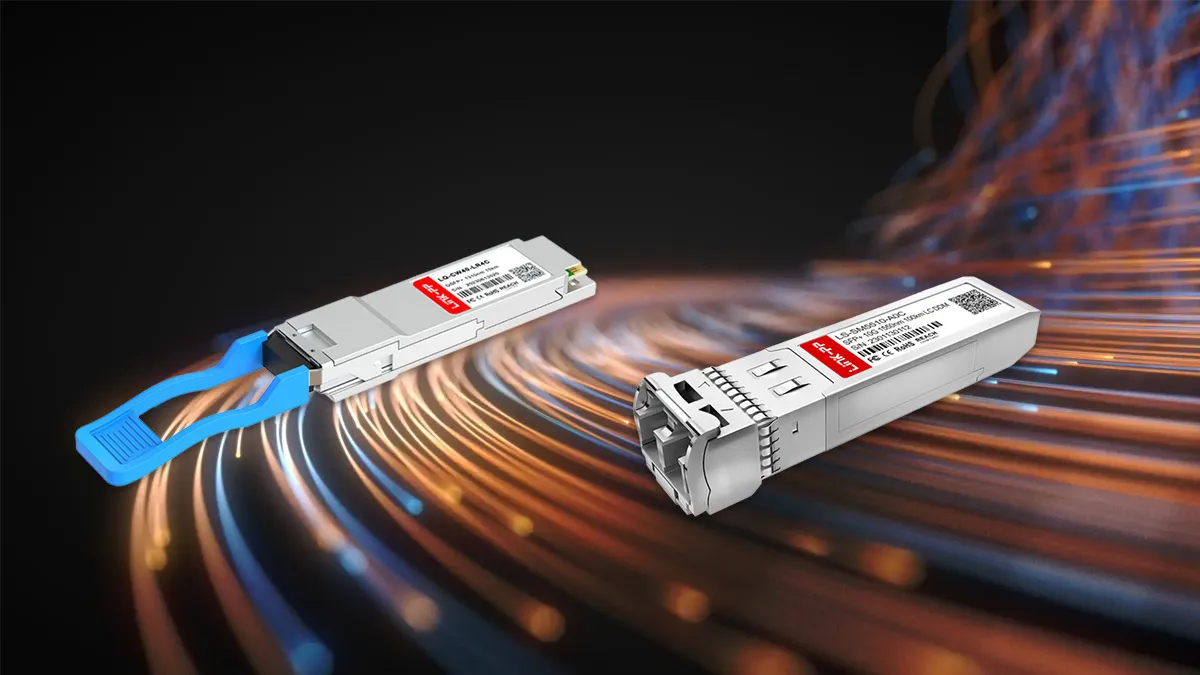
This channel divergence cascades into real-world implications:
-
Port Density Tradeoffs: QSFP slots deliver 4× the bandwidth per rack unit but limit physical connection counts
-
Latency Profiles: SFP+ averages <1μs latency for industrial control systems; QSFP prioritizes throughput over nanosecond optimizations
-
Cost Dynamics: SFP modules cost ~30-50% less per unit but require 4× the ports to match QSFP capacity
Technical Specification Breakdown
| Parameter | SFP/SFP+ | QSFP/QSFP+/QSFP28 |
|---|---|---|
| Channels | 1 | 4 (Independent) |
| Max Speed | 10G (SFP+) | 400G (QSFP-DD) |
| Common Interfaces | LC, SC | MPO/MTP (Multi-fiber) |
| Power Draw | 0.5W-1W | 1.5W-3.5W |
| Reach | 100km (ZX w/ SMF) | 10km (SR4); 80km (LR4) |
| Standards | SFF-8472 | SFF-8436 / QSFP-DD MSA |
Data synthesized from industry specifications
Where Each Excels: Application-Driven Selection
QSFP Dominates In:
-
Hyperscale Data Centers: Spine-leaf architectures using 40G/100G QSFP28 links between core switches reduce cabling complexity by 75% versus SFP+ stacks
-
5G Carrier Networks: Fronthaul connections from 5G DU/CUs demand 25G-100G throughput; QSFP’s MPO interfaces support CPRI/eCPRI aggregation
-
AI/GPU Clusters: NVIDIA’s Quantum-2 InfiniBand uses QSFP56 for 400G HDR interconnects between compute nodes
SFP/SFP+ Prevails In:
-
Industrial IoT: DIN-rail switches with SFP slots provide fiber redundancy for PROFINET systems within harsh factories
-
Enterprise Edge: Branch office switches handling <10G VoIP/video traffic avoid overprovisioning with cost-effective SFP+
-
Legacy Upgrades: Cisco Catalyst 3650 swaps from 1G SFP to 10G SFP+ without chassis replacement
The Cost-Performance Balancing Act
While QSFP modules carry 60-70% higher upfront costs than SFP+, their per-gigabit economics shine in high-utilization environments. A 40G QSFP+ link delivers 4× SFP+10G bandwidth using comparable switch faceplate space, slashing operational overhead6. However, SFP retains advantages for:
-
Tiered Networks: Deploy 10G SFP+ at access layer, reserving QSFP for core uplinks
-
Mixed Media Scenarios: SFP slots accept copper RJ45 modules (100m Cat6A) alongside fiber transceivers
-
Maintenance Sparing: Field-replaceable SFP stock costs less than holding QSFP spares
Future-Proofing Your Fiber Strategy
SFP Evolution: SFP28 (25G) now bridges 10G→100G transitions, avoiding full forklift upgrades. Its backward compatibility with SFP+ ports extends ROI.
QSFP Roadmap: QSFP56-DD (200G/lane) and OSFP (800G) will dominate AI data centers. Existing QSFP28 slots support forward compatibility via breakout cables.
FAQs: Engineer-Level Insights
Q: Can QSFP ports use SFP modules?
A: Only with active adapters (e.g., Cisco QSA). Electrical incompatibilities prevent native support. Verify switch OS compatibility first.
Q: Do QSFP DAC cables outperform optics?
A: For ≤7m server-to-top-of-rack links, yes. DACs consume 50% less power than optical modules but lack diagnostics.
Q: How critical is DDM monitoring?
A: Essential for carrier/cloud networks. SFP’s DOM (Digital Optical Monitoring) and QSFP’s DDM provide real-time temperature/TX power/RX power metrics to prevent outages.
Q: When to choose BiDi SFP vs standard duplex?
A: BiDi SFPs (LC single-port) halve fiber counts by using WDM on one strand. Ideal when conduit space is constrained.
Tags:

-
Nav Menu
-
About LINK-PP
-
All Products
-
Applications