


Understanding the OSFP Standard: The Open 400G/800G Optical Transceiver Platform Powering Next-Gen AI Networks

LINK-PP Official ·


Introduction: The Shift from QSFP-DD to OSFP
As data centers transition from 400G to 800G interconnects, bandwidth demand, power efficiency, and thermal constraints have forced the industry to look beyond traditional form factors.
Enter OSFP (Octal Small Form Factor Pluggable) — an open standard designed to deliver scalable, thermally optimized, and high-density optical connectivity for hyperscale, cloud, and AI-driven environments.
Unlike the backward-compatible QSFP-DD, OSFP introduces a slightly larger mechanical form to accommodate higher power dissipation (up to 15–20W) and supports native 8× lanes for 400G and 800G Ethernet applications.
Defined by the OSFP MSA (Multi-Source Agreement), this open standard is quickly becoming the cornerstone of next-generation optical networking — and a key part of LINK-PP’s advanced transceiver ecosystem.
What Is the OSFP Standard?
OSFP (Octal Small Form Factor Pluggable) is a pluggable optical transceiver interface standard that supports eight electrical lanes (Tx/Rx) per module. Each lane can operate up to 100G PAM4, allowing total bandwidths of 400G or 800G depending on configuration.
OSFP Overview
| Attribute | Specification |
|---|---|
| Lane count | 8 (Tx/Rx) |
| Data rate per lane | 50G or 100G PAM4 |
| Total bandwidth | 400G / 800G |
| Connector | 60-pin edge connector |
| Power consumption | Up to 20W |
| Host interface | OSFP MSA electrical standard |
| Typical applications | 400G/800G Ethernet, AI/ML interconnects, 5G backbones |
OSFP modules are designed to meet the stringent power and cooling requirements of ultra-high-speed systems, while maintaining interoperability across multiple vendors via the open MSA framework.
OSFP vs QSFP-DD: A Structural and Thermal Leap Forward
Although both OSFP and QSFP-DD support 400G and 800G links, their design philosophies differ significantly.
| Feature | QSFP-DD | OSFP |
|---|---|---|
| Electrical lanes | 8×50G PAM4 | 8×50G / 8×100G PAM4 |
| Max data rate | 400G | 800G |
| Power budget | Up to 12W | Up to 20W |
| Backward compatibility | Yes (QSFP28/56) | No |
| Cooling design | Passive airflow | Enhanced direct contact + finned heat sink |
| Size (W×D×H) | 18.35×89.4×8.5 mm | 22.58×107.8×13.0 mm |
| Use case | Broad 400G deployments | High-power AI/800G applications |
QSFP-DD prioritizes port density and legacy support, whereas OSFP focuses on future scalability, thermal headroom, and electrical performance at 100G per lane.
This design makes OSFP ideal for next-generation 800G Ethernet and AI cluster interconnects, where link reliability and power management outweigh form factor size.
OSFP MSA: The Open Design Philosophy
The OSFP Multi-Source Agreement (MSA) defines the complete ecosystem — from mechanical housing to electrical interface and management protocols — ensuring interoperability across optical module vendors and system OEMs.
Key elements of the OSFP MSA include:
- Electrical interface specification supporting 56G and 112G PAM4 lanes
- Mechanical outline and cage design (supports top/bottom cooling airflow)
- Thermal design guidelines up to 20W per module
- Management interface compatible with SFF-8636 (I²C)
- Interoperability roadmap for 400GBASE and 800GBASE Ethernet standards
By keeping the OSFP specification open and vendor-neutral, the MSA ensures wide industry adoption and continuous innovation in high-speed optical networking.
OSFP Form Factors: 400G and 800G Generations
🔹 400G OSFP Modules
400G OSFP transceivers utilize 8×50G PAM4 lanes and comply with IEEE 802.3bs and 802.3cd standards.
Typical variants include:
- 400GBASE-SR8 (MMF, ≤100m)
- 400GBASE-DR4 (SMF, 500m)
- 400GBASE-FR4 (SMF, 2km)
- 400GBASE-LR8 (SMF, 10km)
🔹 800G OSFP Modules
800G OSFP modules use 8×100G PAM4 electrical lanes, doubling throughput for next-generation AI/ML workloads.
Common types include:
- 800GBASE-SR8 (short-reach MMF)
- 800GBASE-DR8 / FR8 / LR8 (SMF up to 10km)
- 800G 2×400G breakout support for flexible network scaling
Inside the OSFP Electrical and Mechanical Design
1️⃣ Electrical Interface
The OSFP interface supports 8 differential TX/RX pairs, each carrying up to 112G PAM4 signaling.
It also defines:
- Power supply pins for 3.3V and auxiliary rails
- Sideband control and monitoring pins
- A two-wire I²C management interface (compatible with SFF-8636)
This design ensures efficient electrical signal integrity and robust host-module communication even at high lane rates.
2️⃣ Mechanical and Thermal Design
The larger OSFP housing allows:
- Improved heat sink integration for up to 20W modules
- Superior airflow management via top/bottom vents
- Optional active cooling for AI rack-scale systems
- Screw-secured cages to ensure EMI and mechanical stability
These design choices make OSFP transceivers ideal for AI servers, supercomputers, and high-density switches with extreme power and heat demands.
3️⃣ OSFP Latch and Ejector Lock Mechanism
Unlike SFP and QSFP modules, which use a simple bail-clasp latch, OSFP introduces a dedicated push-button latch and ejector lock mechanism as part of the MSA mechanical specification. This is a direct consequence of the module's larger size and heavier integrated heatsink — a lighter-duty latch would risk the module working loose under vibration in dense, high-airflow chassis.
How the OSFP lock works:
- A spring-loaded latch on the module body engages a retention clip inside the host cage upon insertion, providing a positive mechanical lock that prevents the module from being pulled out by cable tension alone.
- A push-button release on the front of the module disengages the latch, allowing safe extraction without applying force to the fiber or DAC cable.
- Some OSFP cage designs include an additional port lock/bezel lock feature — a physical latch on the cage itself (not the module) that can be engaged to prevent accidental or unauthorized module removal in shared or unattended environments, distinct from the module's own latch.
| Term | What It Refers To |
|---|---|
| OSFP lock (module latch) | The push-button spring latch built into every OSFP module, standard on all MSA-compliant parts |
| OSFP port lock | An optional cage-level physical lock (sometimes keyed) to prevent module removal, used in secure or high-vibration deployments |
⚠️ Common Mistake: Forcing a module out by pulling on the cable instead of pressing the release button first can damage both the latch mechanism and the cage's retention clip. Always release the latch before removing an OSFP module.
Compliance Standards for OSFP Modules
OSFP modules achieve full interoperability through alignment with multiple industry standards and open MSAs:
| Standard | Description |
|---|---|
| OSFP MSA | Defines OSFP mechanical, electrical, and thermal parameters |
| IEEE 802.3bs / 802.3ck / 802.3df | Defines 400G/800G Ethernet PHY and PMD layers |
| SFF-8636 | Management interface and memory map |
| CMIS (Common Management Interface Specification) | Unified module management protocol |
| Link Training & FEC Requirements | Ensures signal reliability across 112G PAM4 lanes |
By adhering to these standards, LINK-PP OSFP transceivers guarantee full interoperability with major switch ASICs and optical network platforms.
LINK-PP's OSFP 400G/800G Optical Transceiver Solutions
LINK-PP provides a comprehensive line of OSFP 400G and 800G optical transceivers, engineered for compliance with OSFP MSA, IEEE 802.3bs/ck, and CMIS.
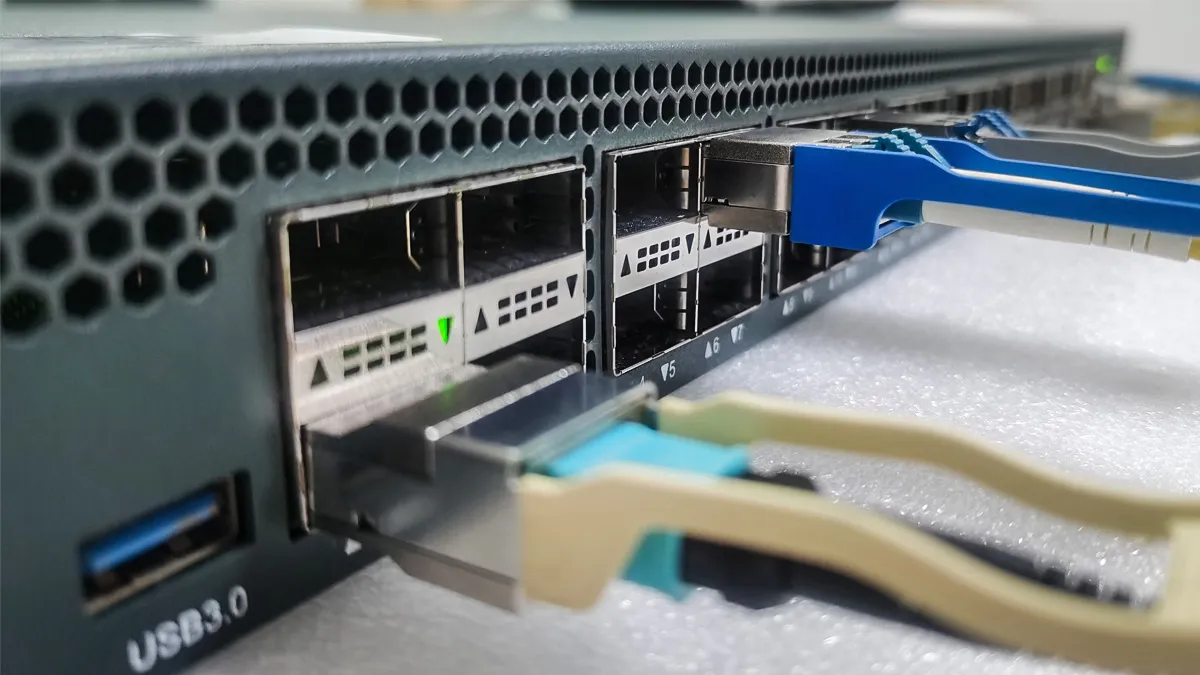
⚙️ Product Highlights
- Fully compliant with OSFP MSA and IEEE 802.3 standards
- Supports 400G and 800G Ethernet links
- 8×100G PAM4 electrical lanes
- Hot-pluggable OSFP form factor
- Built-in DSP-based PAM4 equalization
- Low-latency and low-power design (<20W)
- Digital diagnostics monitoring (DDM) via SFF-8636-compatible I²C
🧪 Performance Testing
Every LINK-PP OSFP module undergoes:
- BER and PAM4 eye mask compliance testing
- CMIS interoperability verification
- Thermal cycling and long-duration burn-in
- Host cage and connector mechanical validation
These ensure enterprise-grade reliability and consistent performance even in AI-scale or HPC clusters.
Applications: Where OSFP Is Leading the Future
- 800G AI/ML supercomputing fabrics (GPU-to-GPU interconnects)
- 400G/800G cloud-scale data centers
- Core and aggregation layers of 5G transport networks
- Ultra-high-density ToR/Spine switches
- Next-generation router and optical line systems
As AI workloads grow exponentially, OSFP’s scalability, cooling efficiency, and high power budget make it the preferred solution for AI-native data centers worldwide.
Technical Advantages of OSFP Modules
✅ Higher Power and Thermal Headroom
Supports up to 20W, allowing 800G operation with reliable cooling.
✅ Scalable to 1.6T Ethernet
Roadmap-ready for 112G×16 lane implementations.
✅ Open Ecosystem
Vendor-neutral MSA encourages broad interoperability and rapid innovation.
✅ Enhanced EMI Shielding
Optimized cage design ensures clean signal integrity in dense rack systems.
✅ LINK-PP Reliability
Built to Telcordia GR-468-CORE optical component reliability standards.
Reference Specifications (Official PDFs)
- OSFP MSA Specification: https://osfpmsa.org/specification.html
- IEEE 802.3bs (400G Ethernet): https://standards.ieee.org/ieee/802.3bs/6748/
- IEEE 802.3df (800G Ethernet): https://standards.ieee.org/ieee/802.3df/11107/
- CMIS 5.0: https://www.oiforum.com
Frequently Asked Questions
What is the OSFP lock mechanism?
OSFP modules use a spring-loaded push-button latch that mechanically secures the module inside the host cage, distinct from the simpler bail-clasp latch used on SFP/QSFP modules. Press the release button on the module face to disengage it before removal.
What is an OSFP port lock?
An OSFP port lock is an optional cage-level physical lock, separate from the module's own latch, used to prevent accidental or unauthorized removal of a module in secure or high-vibration data center environments.
Conclusion: LINK-PP OSFP — Powering the 800G Era
The OSFP standard marks a pivotal step toward scalable 400G and 800G optical networking, designed from the ground up for AI, cloud, and HPC infrastructures.
With open MSA collaboration and superior thermal capacity, OSFP is not merely an upgrade — it's the foundation for terabit-scale connectivity.
LINK-PP's OSFP 400G/800G transceivers embody this evolution, offering full standards compliance, low power, and high signal integrity for future-ready networks.
As the data economy advances toward AI-driven 800G and 1.6T systems, OSFP — and LINK-PP's solutions — will continue to lead the optical frontier.
Related Topics & Further Reading

-
Nav Menu
-
About LINK-PP
-
All Products
-
Applications