


SMT LAN Transformers: Design Transformator Guide, Selection & Testing

LINK-PP Official ·


With the rapid evolution of Ethernet technologies, IoT, cloud computing, and 5G infrastructure, LAN transformers have become critical in ensuring reliable, high-speed data transmission. These components provide galvanic isolation, signal conditioning, and electromagnetic interference (EMI) suppression across networking devices. Among different mounting techniques, Surface Mount Technology (SMT) is now the industry standard for high-density PCB designs. This guide provides an in-depth overview of SMT LAN transformer design, selection, testing, and application, leveraging insights from LINK-PP, a global leader in network magnetics.
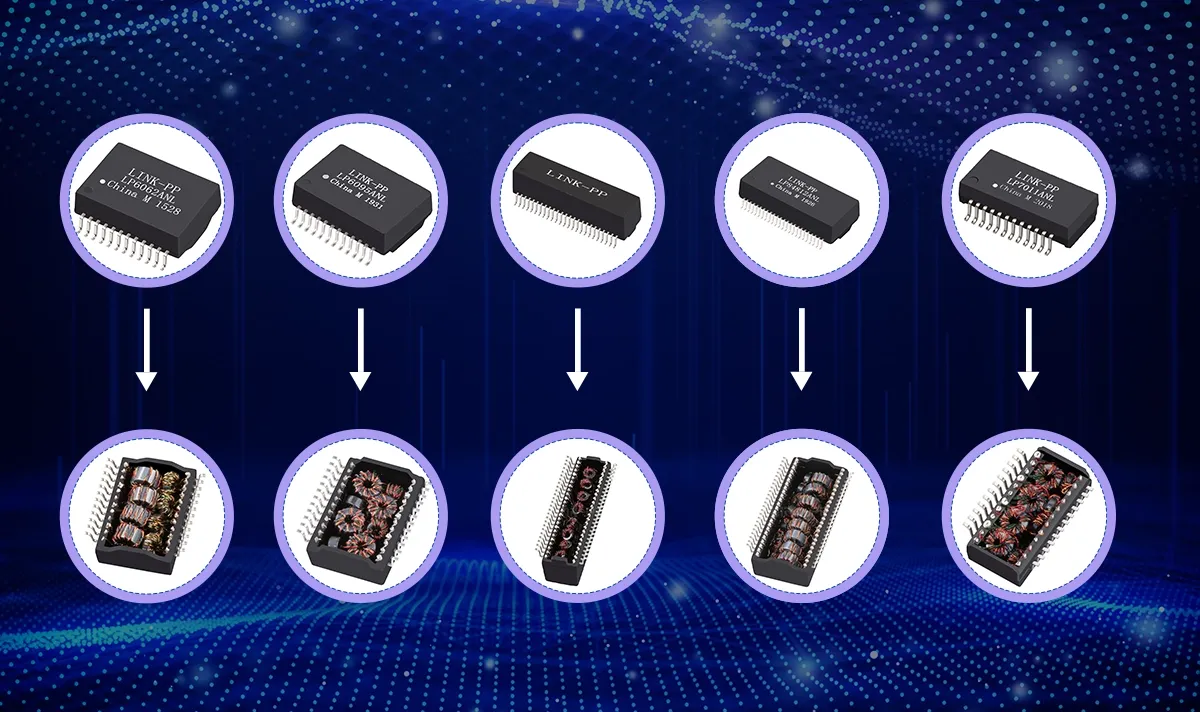
💡 What is a LAN Transformer?
A LAN transformer, also known as an Ethernet transformer or network magnetic, is a passive component that performs three essential functions:
- Signal Isolation: Provides galvanic isolation between the Ethernet PHY and the cable interface.
- Impedance Matching: Ensures proper impedance levels to minimize reflections and signal loss.
- Common Mode Noise Rejection: Reduces EMI and supports compliance with IEEE 802.3 standards.
Compared to traditional through-hole (THT) transformers, SMT LAN transformers offer compact footprints, superior high-frequency performance, and compatibility with automated assembly, making them ideal for routers, switches, servers, industrial controllers, and PoE devices.
✨ Why SMT is the Preferred Choice
Transitioning from THT to SMT LAN transformers provides manufacturers with numerous benefits:
- High-Density PCB Optimization: Compact design maximizes board space for IoT, telecom, and industrial devices.
- Improved Signal Performance: Lower parasitic inductance ensures high-speed Ethernet performance.
- Automated Production & Cost Efficiency: Fully compatible with pick-and-place and reflow soldering, lowering manufacturing costs.
- Consistency & Reliability: SMT enables uniform solder joints and scalable quality assurance.

Optimized SMT LAN Transformers for high-speed Ethernet designs
🔧 Key Design and Selection Considerations
-
Electrical Performance:
Evaluate insertion loss, return loss, and common-mode rejection ratio (CMRR). Higher CMRR ensures better EMI suppression and adherence to IEEE 802.3 standards. -
PCB Footprint & Package Precision:
Accurate pad layouts are critical. LINK-PP provides detailed datasheets to ensure reliable soldering and signal integrity. -
Thermal & Mechanical Reliability:
Components must withstand reflow cycles and mechanical stress from connector insertion. Reinforcement techniques, such as underfill, can enhance durability. -
Signal Integrity & EMI Management:
Optimize trace routing, grounding, and shielding to minimize noise and maintain high-speed performance. -
PHY Compatibility:
Verify interoperability with major Ethernet PHYs (Broadcom, Intel, Realtek, Marvell) to prevent link failures.
🛡️ Testing and Quality Assurance
Robust testing ensures reliable performance under various conditions. Typical validation includes:
- High-Speed Signal Testing: Eye diagram, return loss, and insertion loss measurements for 100M/1G/10G Ethernet.
- EMI/EMC Compliance: Ensures noise suppression within IEEE limits.
- Thermal Cycling & Reliability Tests: Confirms durability under temperature and humidity fluctuations.
- Automated Optical Inspection (AOI): Guarantees defect-free soldering on SMT assembly lines.
🌐 Applications of SMT LAN Transformers
- Enterprise & Data Center Switches and Routers
- PoE-enabled devices (IP phones, cameras, access points)
- Industrial IoT controllers and smart factory equipment
- Automotive Ethernet for ADAS and infotainment systems
- 5G small cells and telecom base stations
🏆 LINK-PP: Trusted Network Magnetics Partner
LINK-PP is a global supplier of high-performance LAN magnetics, trusted by top OEMs in networking, telecom, and industrial automation. Our SMT LAN transformer portfolio provides:
- Full IEEE 802.3 Ethernet compliance
- RoHS & REACH certified components
- Compatibility with leading PHY chipsets
- Custom design support for specialized applications
➡️ Explore our SMT LAN transformer catalog:
🔗 LINK-PP SMT LAN Transformers
✅ Conclusion
As Ethernet scales toward higher speeds and broader applications, SMT LAN transformers are the backbone of compact, reliable, and high-performance network designs. By implementing best practices in design, selection, and testing, manufacturers can ensure compliance, long-term reliability, and optimal signal integrity. With LINK-PP’s expertise and proven solutions, you gain a trusted partner committed to quality, innovation, and global support for modern networking applications.
❓ FAQ
Do SMT LAN transformers support PoE?
Yes. They handle DC bias currents for PoE while maintaining proper isolation and signal integrity.
What is the standard isolation voltage for Ethernet transformers?
Typically 1500V–2000V galvanic isolation, per IEEE/TIA/EIA recommendations, to protect connected devices from voltage surges.
Can LAN transformers improve network performance?
Indirectly, by reducing EMI, maintaining signal integrity, and preventing reflections, they support high-speed data transmission reliably.
Tags:

-
Nav Menu
-
About LINK-PP
-
All Products
-
Applications