


DWDM Multiplexer & OADM: Complete Guide to MUX Technology

LINK-PP Official ·


A multiplexer, or MUX, is a core component in digital electronics and telecommunications. It allows multiple input signals to be transmitted over a single output line, maximizing bandwidth efficiency and streamlining communication networks. From basic digital logic to advanced optical networking technologies such as DWDM and OADM, multiplexers play a vital role in modern systems.
Fundamentals of Multiplexing
The principle of multiplexing lies in channeling multiple signals across one communication line. Similar to a traffic controller, a MUX directs signals efficiently, preventing interference and ensuring optimal use of available bandwidth.
2:1 MUX – The Basic Concept
The simplest MUX is the 2:1 configuration, where two input signals share a single output line. A binary selector bit determines which input is passed to the output. This basic logic is the foundation of larger MUX designs.
Truth Table of a 2:1 MUX
| Select (S) | Input 0 (I0) | Input 1 (I1) | Output (Y) |
|---|---|---|---|
| 0 | 0 | 0 | 0 |
| 0 | 0 | 1 | 0 |
| 0 | 1 | 0 | 1 |
| 0 | 1 | 1 | 1 |
| 1 | 0 | 0 | 0 |
| 1 | 0 | 1 | 1 |
| 1 | 1 | 0 | 0 |
| 1 | 1 | 1 | 1 |
Boolean Expression
The Boolean equation for a 2:1 multiplexer is shown below:

Types of MUX and Applications in Digital Systems
Multiplexers come in different configurations: 2:1, 4:1, 8:1, 16:1, and beyond. Each ratio serves a different complexity level in circuit design and system requirements.
MUX in Computer Architecture
In processors, MUXes are integral to Arithmetic Logic Units (ALUs). They select the correct data path for operations such as addition, subtraction, and logical comparisons—boosting processing efficiency.
MUX in Digital Signal Processing
Signal processors use MUXes to manage data flow for precise and real-time processing. By controlling which signals are routed for computation, MUXes ensure timing accuracy and maintain data integrity.
Switch MUX and MUX Switch in Networking
In communication networks, MUX switches manage traffic between multiple input and output sources. They optimize bandwidth usage, improve transmission efficiency, and reduce bottlenecks.
MUX Applications in Technology

MUX technology is indispensable across a multitude of technological domains, particularly in communication systems, computer memory management, and data routing. Their role in data compression and transmission efficiency is critical, especially in applications like digital video broadcasting and telecommunication networks.
From Digital Multiplexing to Optical Networks
As bandwidth demands grew beyond electrical circuits, multiplexing principles were applied to optical fiber systems. This gave rise to Wavelength Division Multiplexing (WDM), where each channel carries data on a separate wavelength of light.
Optical Add-Drop Multiplexers (OADM)
An Optical Add-Drop Multiplexer (OADM) is a critical device in WDM and especially Dense WDM (DWDM) networks. It enables specific wavelengths to be inserted (add) or removed (drop) without disturbing other channels, allowing highly flexible traffic management.
How OADM Works
OADMs selectively manipulate wavelengths in an optical fiber. By targeting specific channels, they allow traffic to be rerouted locally while other wavelengths continue through unaffected.
Applications of OADM
- Long-haul telecom backbone networks
- Regional ISP routing and service insertion
- Dynamic bandwidth management in metropolitan networks
Advantages of OADM
Key benefits include scalability, cost-efficiency, and seamless integration of new services. OADMs allow networks to grow and adapt without requiring additional fiber infrastructure.
Dense Wavelength Division Multiplexing (DWDM) Multiplexer
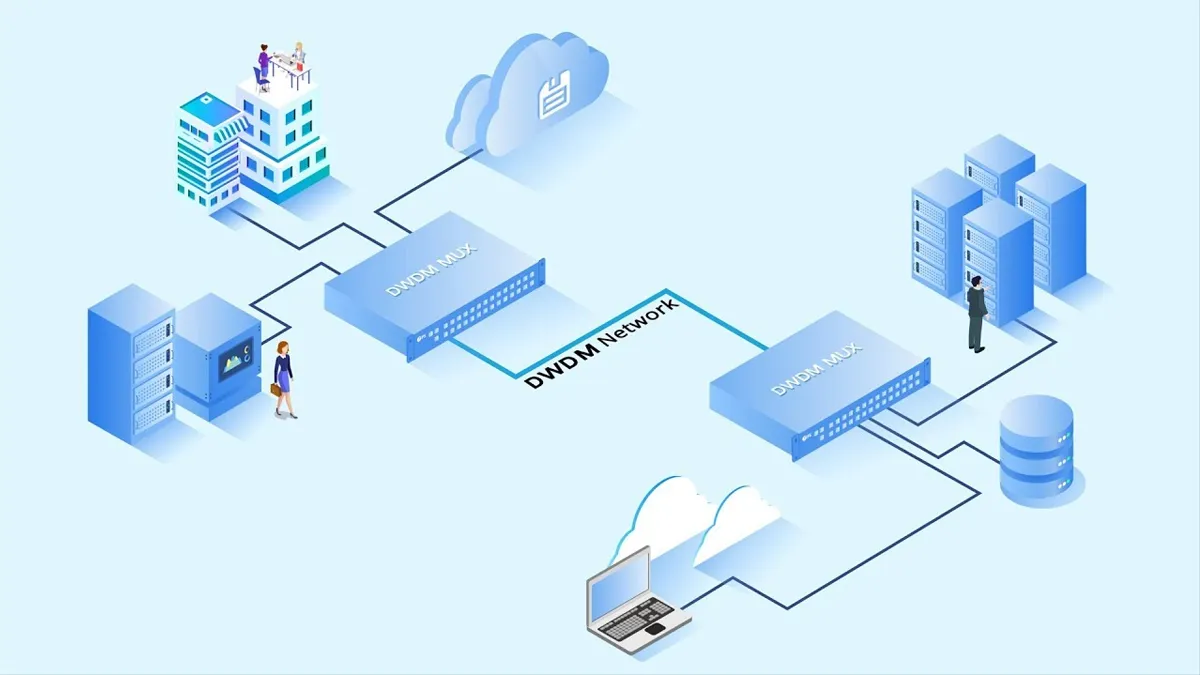
A DWDM Multiplexer (MUX) combines multiple wavelengths into a single optical fiber, dramatically increasing capacity. On the receiving end, a Demultiplexer (DEMUX) separates the channels back into individual signals. DWDM MUXes typically follow ITU-T standards and can support 40, 96, or even 160 channels with 100 GHz or 50 GHz spacing.
DWDM MUX vs OADM
| Feature | DWDM Multiplexer (MUX/DEMUX) | OADM |
|---|---|---|
| Function | Combines/splits multiple wavelengths | Adds/drops specific wavelengths |
| Network Layer | Core/backbone transmission | Metro and regional routing |
| Scalability | High channel density | Flexible wavelength-level control |
Applications of DWDM MUX and OADM
- Telecommunications – Expanding backbone bandwidth
- Data Centers – High-capacity interconnects
- Enterprises – Disaster recovery and business continuity
- ISPs – Local service distribution using OADM

Practical Example: Building a 3:1 MUX with 2:1 MUXes
- Inputs & Select Lines: Use three inputs (I0, I1, I2) and two select lines (S0, S1).
- Configuration: Connect I0 and I1 to the first 2:1 MUX. Then feed its output and I2 into a second 2:1 MUX.
- Operation: S0 and S1 determine which input reaches the output, illustrating scalable design.
Conclusion
Multiplexing technology—from simple 2:1 digital MUXes to advanced DWDM optical systems—forms the backbone of data transmission efficiency. OADMs provide flexible traffic management, while DWDM MUXes enable terabit-scale transmission. Together, they ensure networks are scalable, cost-effective, and ready for future bandwidth demands.
Frequently Asked Questions (FAQ)
Q1: What is the difference between DWDM and CWDM?
DWDM supports tighter channel spacing (50/100 GHz) for long-distance, high-capacity links, while CWDM uses wider 20 nm spacing for shorter, cost-sensitive deployments.
Q2: Can OADM function without a MUX/DEMUX?
No. OADM works alongside DWDM MUX/DEMUX systems to selectively add or drop wavelengths.
Q3: How many channels can a DWDM MUX support?
Commercial DWDM MUXes typically range from 4 to 160 channels, depending on ITU-T compliance and vendor design.
Tags:

-
Nav Menu
-
About LINK-PP
-
All Products
-
Applications