


A Deep Dive into 100G QSFP28 Single Lambda Modules for Modern Data Centers

LINK-PP Official ·


In today's data-driven world, data centers are the backbone of digital transformation, cloud computing, and AI applications. Achieving ultra-high-speed and reliable connectivity has never been more critical. Among the latest advancements, 100G QSFP28 single lambda optical modules have emerged as a game-changer, offering a cost-effective, scalable solution tailored for modern data center networks.
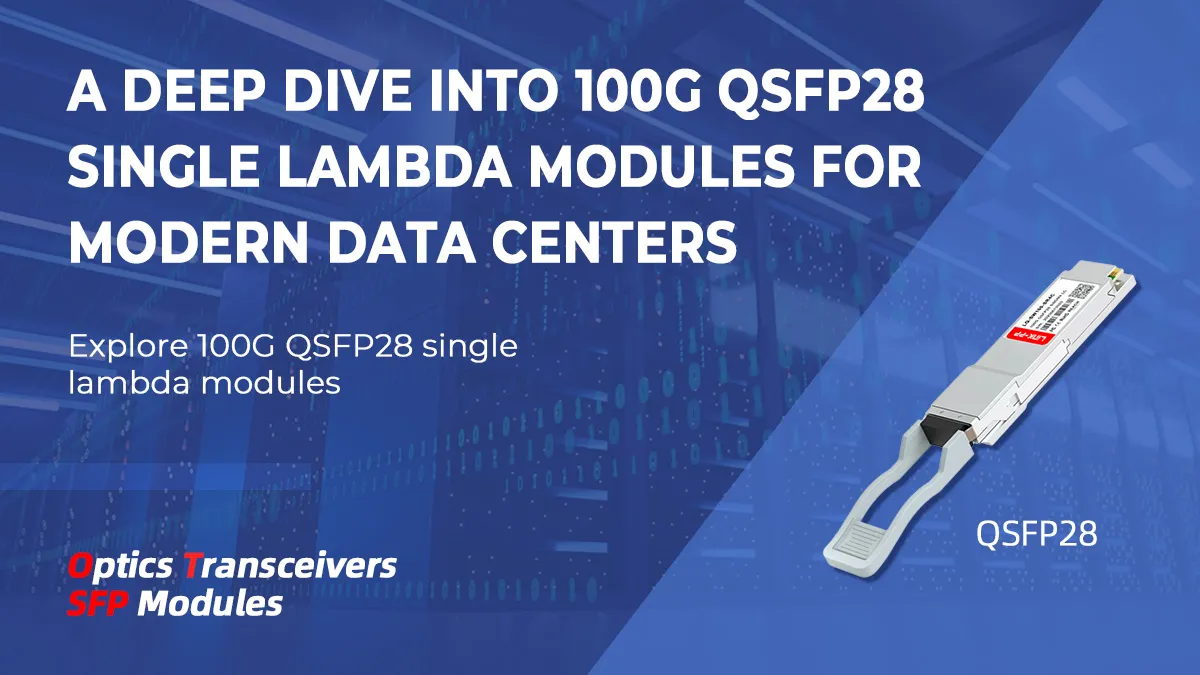
This article explores the technology behind 100G QSFP28 single lambda modules, their benefits, applications, and why they are becoming the preferred choice for next-generation data centers.
Understanding 100G QSFP28 Single Lambda Modules
What Is a QSFP28 Module?
QSFP28 (Quad Small Form-factor Pluggable 28) is a compact, hot-pluggable transceiver designed to support data rates up to 100 Gbps. Each QSFP28 port typically handles four lanes of 25 Gbps each, aggregating to a total of 100 Gbps.
The Single Lambda Concept Explained
Traditional 100G QSFP28 modules use four separate optical wavelengths (lambdas), each transmitting at 25 Gbps. In contrast, single lambda QSFP28 modules transmit the entire 100 Gbps signal on a single wavelength at 100 Gbps, simplifying the optical design and potentially lowering system costs.
Key Advantages of Single Lambda 100G QSFP28 Modules
1. Simplified Network Architecture
By utilizing one wavelength for the full 100G signal, single lambda modules reduce the complexity of multiplexing and demultiplexing optics, streamlining the physical layer in fiber optic links.
2. Cost-Effectiveness
Fewer components and simpler optics mean lower manufacturing costs. For large-scale deployments, this cost saving becomes significant, making single lambda modules a compelling choice for hyperscale data centers.
3. Enhanced Compatibility and Flexibility
Single lambda modules often support multiple fiber types (single-mode or multimode) and offer extended reach options (up to 10 km or more), fitting a broad range of data center architectures, including spine-leaf and inter-rack connections.
4. Improved Power Efficiency
With reduced optical components, these modules typically consume less power, helping data centers meet strict power and cooling budgets.
Applications in Modern Data Centers
- High-Speed Interconnects: Backbone links between core switches and aggregation layers.
- AI and Machine Learning Clusters: Demanding ultra-low latency and high bandwidth for model training.
- Cloud Service Providers: Scaling infrastructure cost-effectively to meet exponential traffic growth.
- Enterprise Networks: Future-proofing network architecture for 5G, IoT, and big data analytics.
How Single Lambda 100G QSFP28 Modules Compare to Traditional Multi-Lambda Designs
| Number of Wavelengths | 4 × 25 Gbps | 1 × 100 Gbps |
| Optical Complexity | Higher | Lower |
| Cost | Higher | Lower |
| Power Consumption | Higher | Lower |
| Network Architecture | More Complex | Simpler |
| Reach | Up to 10 km (varies) | Up to 10 km or more |
Industry Standards and Compliance
Single lambda QSFP28 modules adhere to key industry standards such as IEEE 802.3bm and IEEE 802.3cd, ensuring interoperability and compliance with the latest 100G Ethernet specifications. They support Digital Diagnostic Monitoring (DDM) for real-time status reporting of critical parameters like temperature, voltage, and optical power, enhancing network reliability and maintainability.
Best Practices for Deployment
- Compatibility Checks: Verify that network switches and routers support single lambda QSFP28 modules.
- Fiber Infrastructure: Ensure the fiber cabling meets required specifications (e.g., OM4/OM5 for multimode, OS2 for single-mode).
- Temperature and Environment Control: Maintain data center conditions within specified operating ranges to maximize module lifespan.
- Testing and Certification: Employ appropriate testing tools to validate link performance and error rates post-installation.
Future Trends in 100G Optical Modules
As data center demands escalate, the industry is moving toward even higher speeds such as 200G and 400G, often leveraging multi-lambda and advanced modulation techniques (e.g., PAM4). However, single lambda 100G QSFP28 modules remain a vital bridge technology, balancing performance, cost, and simplicity for current deployments.
Conclusion
100G QSFP28 single lambda optical modules offer a streamlined, cost-effective, and flexible solution for modern data centers striving for high-speed, scalable connectivity. Their simplified design reduces optical complexity and power consumption while maintaining industry compliance and reliability.
By understanding the technical benefits and deployment best practices, network engineers and IT architects can make informed decisions to optimize their infrastructure for today’s and tomorrow’s data challenges.
Frequently Asked Questions (FAQ)
Q1: What is the main difference between single lambda and multi-lambda 100G QSFP28 modules?
A: Single lambda modules transmit 100 Gbps over one wavelength, whereas multi-lambda modules use four separate 25 Gbps wavelengths.
Q2: Are single lambda QSFP28 modules compatible with existing network equipment?
A: Compatibility depends on the switch/router vendor and model. Always check vendor specifications before deployment.
Q3: What is the typical reach of single lambda 100G QSFP28 modules?
A: Depending on the model and fiber type, reaches can vary from 100 meters on multimode fiber to up to 10 km or more on single-mode fiber.
Q4: How does power consumption compare between single lambda and multi-lambda QSFP28 modules?
A: Single lambda modules generally consume less power due to reduced optical components.
📌 Related Topics & Further Reading
- For module types comparison, see QSFP vs SFP Transceiver Comparison.
- Learn about high-speed modulation in NRZ vs PAM4 Modulation Comparison.
- Fiber choice explained in Single-Mode vs Multimode Fiber.
- Understand monitoring in DDM in SFP Modules.
- Future trends covered in QSFP-DD vs OSFP Comparison.
- Module types detail in 100G QSFP28 Module Types.
Tags:

-
Nav Menu
-
About LINK-PP
-
All Products
-
Applications