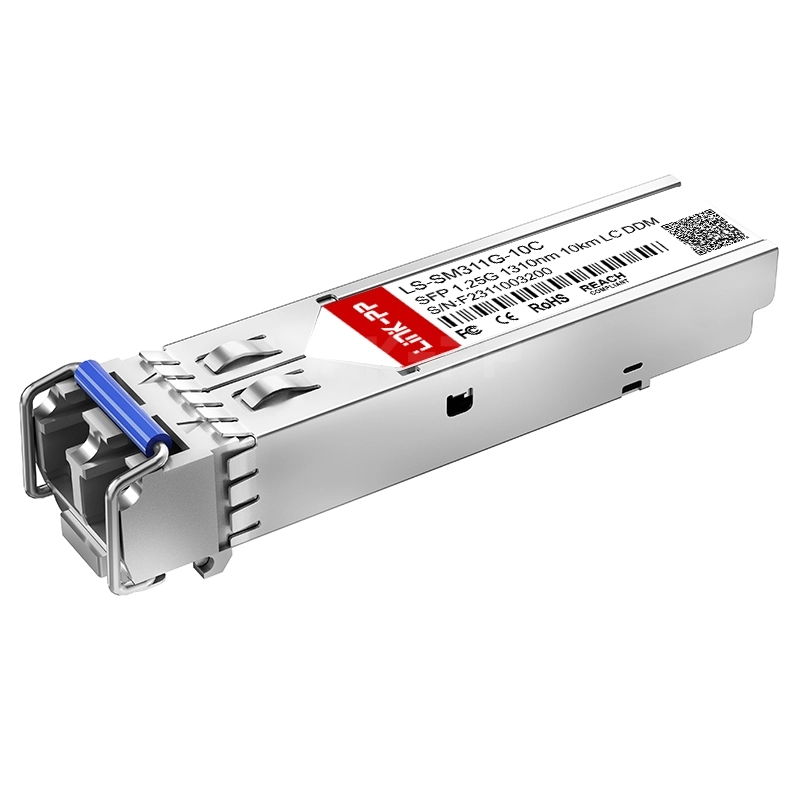
10G optical networks have expanded beyond traditional data centers into enterprise campuses, security monitoring systems, edge computing environments, and industrial deployments. Many of these links fall within short-range applications—typically 100 to 300 meters inside buildings, server rooms, or equipment clusters. Selecting the right 10G SFP+ module for these scenarios is essential to ensure stable bandwidth while minimizing cost, power consumption, and maintenance overhead.

Why Short-Range Environments Need Dedicated 10G SFP+ Modules
Short-range links may seem simple, but using modules designed for longer distances can lead to inefficiencies. Dedicated short-range 10G modules offer clear advantages:
- Better Technical Fit
Short-range links pair optimally with multimode fiber or short-reach copper solutions. They offer relaxed power budgets, higher tolerance for signal dispersion, and simpler installation compared to long-reach modules. - Cost Efficiency
Short-range modules rely on mature VCSEL technology for optical links, which is more cost-effective than long-reach lasers requiring single-mode fiber. This reduces project expenses without compromising performance. - Lower Power and Thermal Footprint
Short-range modules consume less power than long-reach alternatives, easing cooling demands in dense server racks. Over hundreds of ports, this difference becomes significant in operational costs. - Simpler Maintenance
Short-range modules reduce the need for complex optical budgeting, attenuators, or signal optimization. They simplify deployment and long-term maintenance, keeping networks stable.
Overview of Short-Range 10G SFP+ Solutions
Short-range 10G connectivity can be realized through a combination of optical and copper solutions. The main options include:
| Solution Type | Interface | Medium | Typical Reach | Applications | Advantages | Limitations |
|---|---|---|---|---|---|---|
| Short-Reach Optical | SFP+ LC Duplex | OM3/OM4 Multimode Fiber | 100–300m | Server-to-switch, switch-to-switch, intra-rack/inter-rack | Low power, cost-effective, easy deployment | Requires multimode fiber; not for long distances |
| Copper 10GBASE-T | SFP+ RJ45 | Cat6A/Cat7 | 1–30m | Adjacent racks, retrofitting existing copper | Reuse existing cabling, flexible | Higher power, limited reach |
| Legacy Multimode Optical | SFP+ LC Duplex | OM1/OM2 Fiber | ~200m | Upgrading older installations without recabling | Allows 10G over existing legacy fiber | Limited to older fiber types; not for new builds |
| DAC (Direct Attach Copper) | SFP+ Connector | Twinax Copper | 1–7m | In-rack links, switch stacking | Ultra-low latency, low power, simple cabling | Very short reach; thick cable in high-density racks |
| AOC (Active Optical Cable) | SFP+ Connector | Multimode Fiber | 3–30m | Short inter-rack high-density links | Lightweight, flexible, pre-terminated | Higher cost than DAC; fixed lengths |
| QSFP+ Breakout | QSFP+ to 4×SFP+ | Copper/Fiber | DAC: ~7m, AOC: ~30m | ToR/leaf switches, 40G uplink broken into 10G links | Efficient port utilization, high-density downlinks | Requires breakout support; short-range by nature |
Three-Step Selection Framework
Selecting the optimal short-range 10G module can be simplified into three practical steps:
- Check Your Existing Cabling
- Multimode fiber (OM3/OM4): Short-reach optical modules are ideal; DAC/AOC can be considered for very short links.
- Legacy multimode fiber (OM1/OM2): Upgrade with short-range optical modules or legacy-compatible modules to preserve existing infrastructure.
- Copper cabling (Cat6A/Cat7): 10GBASE-T modules or short-range DAC are preferred to reuse copper infrastructure.
- Match the Required Distance
- ≤7m: Use DAC; 10GBASE-T is an alternative when copper reuse is necessary.
- 7–30m: Use AOC or short-reach optical modules with multimode fiber patch cords.
- 30–300m: Standard short-reach optical modules over OM3/OM4 multimode fiber.
- Review Port and Expansion Needs
- High-density uplinks (40G breakout): Use QSFP+ to 4×10G breakout DAC/AOC for efficient downlink distribution.
- Power efficiency and port density: Minimize 10GBASE-T usage; prioritize short-reach optical modules or DAC/AOC solutions.
LINK-PP Solutions for Short-Range Networks
LINK-PP provides a robust portfolio of short-range 10G modules and cables that are multi-vendor compatible and designed for real-world deployment:
- Short-Reach Optical Modules: Optimized for multimode fiber with low power consumption and high reliability.
- DAC and AOC Cables: Flexible solutions for in-rack and inter-rack connections, offering low latency and pre-terminated convenience.
- QSFP+ Breakout Solutions: Enable high-density 10G downlinks from 40G uplinks, simplifying cabling and reducing operational complexity.
These solutions help enterprises and data centers balance bandwidth, power, cost, and maintenance requirements efficiently, while future-proofing networks for higher speeds.
Future-Proofing Short-Range 10G Networks
While planning short-range networks, consider:
- Scalability: Use modules and cables that support future upgrades (e.g., 25G or 40G).
- Energy efficiency: Prioritize low-power solutions for dense deployments.
- Ease of maintenance: Favor pre-terminated, plug-and-play options to reduce downtime.
By aligning cabling, distance, and port requirements with the right module type, organizations ensure reliable performance while optimizing operational costs.
Conclusion
Short-range 10G SFP+ deployment is not a “one size fits all” decision. Choosing modules based on existing cabling, required distance, and port density ensures:
- Optimal bandwidth utilization
- Cost efficiency and lower power consumption
- Simpler installation and maintenance
Solutions such as short-reach optical modules, DAC/AOC cables, and QSFP+ breakout assemblies provide flexible, reliable, and future-ready short-range 10G connectivity. Leveraging multi-vendor compatible solutions ensures seamless integration and long-term network stability.
🔗 Related Topics & Further Reading
- What is an SFP Module? The Ultimate Guide (Types, Speeds & Compatibility)
- Understanding the SFF-8432 Standard: Mechanical Design Framework for SFP+ Optical Transceivers
- Top 10G SFP+ Fiber Modules for Enterprise Networks: A Strategic Deployment Guide
- The Ultimate Guide to SFP, SFP+, SFP28, QSFP+, and QSFP28: Optimizing Network Infrastructure for Modern Data Demands
- 10G SFP+ Modules: Technical Specifications, Variant Selection & Strategic Deployment Guide
- SFP Compatibility Master Guide: SFP+ vs SFP28 vs QSFP28 Interoperability